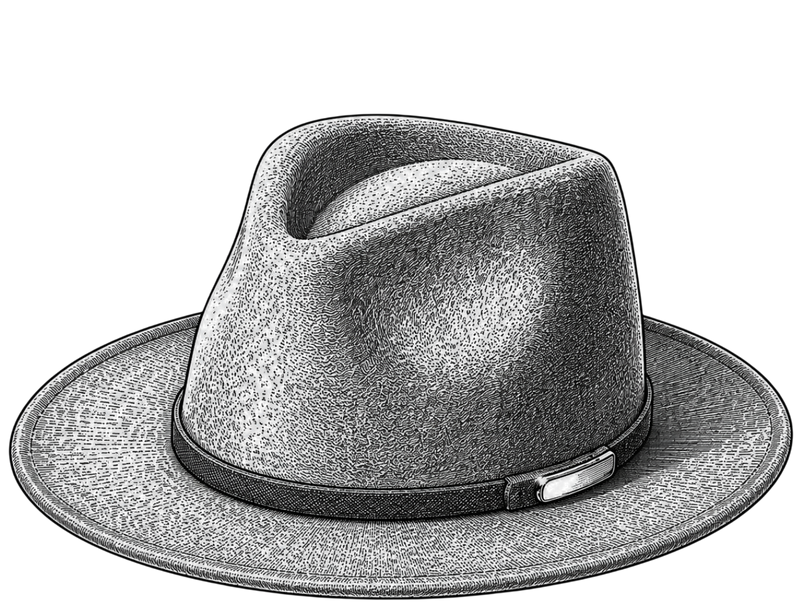
A brim's curl isn't decorative shaping added at the end. It's a structural property set during blocking that either holds for years or collapses within months.
How a Proper Curl Is Set
- Steaming the brim edge: Makes the felt or straw pliable enough to shape without cracking.
- Shaping over a curved flange or by hand: The curl is formed while the material is still warm and workable.
- Setting under controlled cooling: The material hardens into the curled shape as it cools, locking in the curve.
Fact: A properly set curl returns to its shape after being pressed flat by hand — this "memory" is a direct result of the material being shaped and cooled correctly during blocking, not something that can be added after the fact with surface treatments.
Signs of Poor Curl Construction
| Sign | Indicates |
|---|---|
| Brim stays flat after being pressed down | Curl wasn't properly set during blocking |
| Uneven curl around the circumference | Rushed or inconsistent shaping process |
| Cracking at the curl point | Insufficient steaming before shaping |
Bottom line: A brim's curl memory is set permanently during the blocking process — it's a structural craftsmanship marker, not a cosmetic detail, and it's testable by hand before you even buy.
Frequently Asked Questions
Can I re-curl a hat brim that has lost its shape at home?
Yes, with steam and patience. Steam the brim edge until the felt is pliable — a garment steamer or carefully held kettle steam works for this. While warm and workable, reshape the curl by hand to the desired angle. Hold in position while cooling or use a clip or wrap to maintain the curl during the set. Allow to fully cool before handling. The result won't be as consistent as factory blocking but can significantly restore a flattened curl. If the felt cracks during reshaping, the material was too dry when shaped — steam more thoroughly next time.
Why does some hat brim curls look uneven or inconsistent around the circumference?
Inconsistent shaping during blocking. A uniform curl requires either a precise curved flange (the factory tool for this step) or a very skilled hand-shaping process that applies consistent pressure around the full circumference as the material cools. Rushed production or inadequate tooling leaves the curl tighter in some sections and flatter in others. This is visible from the front — the curl should describe a smooth, even arc around the brim, not irregular curves and flat sections.
What's the difference between an upturn and a downturn brim curl, and does the setting process differ?
Direction only — the process is identical. Whether the curl is up (as on a cowboy hat brim) or down (as on many fedoras) is determined by which direction the brim is shaped over during blocking. The steam, shape-while-warm, cool-in-position process applies the same way. The structural quality of the curl — how well it holds and how consistent it is — is independent of direction and determined entirely by the precision of the blocking and cooling process.
Related Reading
- How Hat Blocking Works: The Technique Behind Every Great Hat
- How We Test Every Hat for Shape Retention Before It Ships
- The Anatomy of a Hat: Every Component Explained
Shop Hatloom
Fedoras and structured hats with properly blocked brim curls — curl memory verified by the compression test before each hat ships.