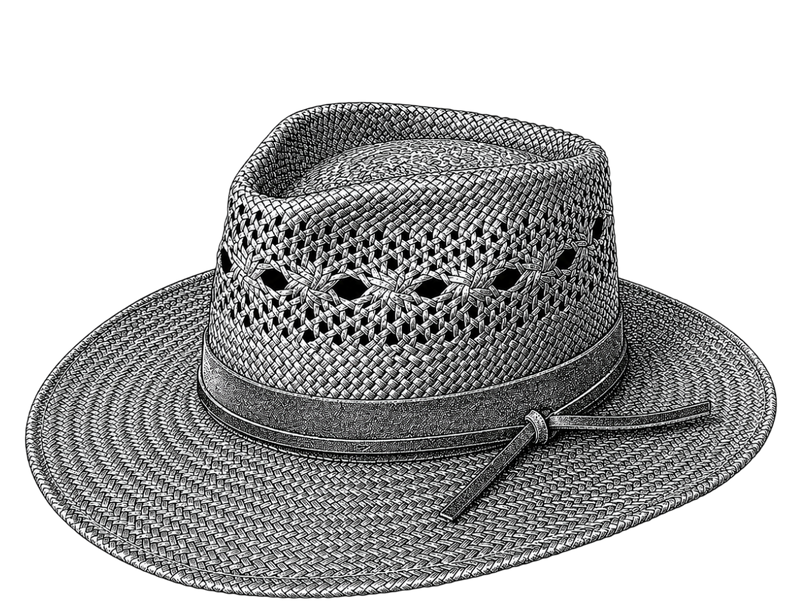
Blocking is the step that turns a flat piece of felt into a three-dimensional hat — and it's almost entirely manual, even in modern production.
The Blocking Process
- Steaming: Felt is steamed to become pliable and workable without tearing.
- Shaping over the block: The softened felt is stretched and pressed over a solid wooden hat block carved to the exact crown shape and size.
- Brim shaping: A separate flange or block shapes the brim's curve and curl while the felt is still pliable.
- Cooling and setting: The felt cools and hardens into the block's shape, retaining that form once removed.
Insight: Wooden hat blocks are sized to precise head circumferences and crown styles — the same block can be reused indefinitely, meaning a hatmaker's collection of blocks effectively defines their entire size and style range.
Why Blocking Quality Matters
| Blocking Quality | Result |
|---|---|
| Precise, even pressure | Symmetrical crown, accurate sizing |
| Rushed or uneven | Asymmetry, fit inconsistency |
| Insufficient steaming | Felt resists shaping, weaker hold |
Bottom line: Blocking is the manual step that determines a hat's actual shape and fit accuracy — even highly mechanized production still relies on this fundamentally hands-on process.
Frequently Asked Questions
Can a blocked hat be reshaped at home using steam?
Yes, with care. A hat that has lost its shape can be re-steamed and reformed by hand over a bowl of steam or with a garment steamer, then reshaped and allowed to cool on a hat block or similar curved support. The felt will become pliable again with heat and moisture, allowing minor shape corrections. This is the same basic principle as factory blocking — the difference is the precision of the tool (a carved wooden block versus improvised support) and the steam intensity. For major reshaping, professional blocking by a milliner is more reliable.
Why do two hats of the same labeled size fit differently?
Blocking variation. Even if two hats use identical felt and the same labeled size, the block used — and how precisely the felt was centered and pressed during blocking — determines the actual internal dimensions. Slight asymmetry in pressing or variation between block sets at different manufacturers produces fits that differ even with matching size labels. This is why measuring your head in centimeters and comparing to specific product measurements (rather than relying on size label alone) produces more consistent results.
What is the difference between a hand-blocked and machine-blocked hat?
Primarily consistency and crown profile precision. Machine-blocking applies even hydraulic pressure across the block, producing highly consistent crown geometry across production runs. Hand-blocking allows more nuanced shaping — the skilled blocker can correct asymmetry or adjust curve during the pressing step in ways a press cannot. At the high end, hand-blocking is considered superior for complex crown profiles; for standard fedora and cap profiles, precision machine-blocking produces excellent results.
Related Reading
- Inside the Wool Felt-Making Process: From Raw Fiber to Finished Hat
- What Grade of Wool Felt Do We Use, and Why It Matters
- The Anatomy of a Hat: Every Component Explained
Shop Hatloom
Blocked and finished wool felt hats — crown style and sizing method disclosed per listing so you can verify fit accuracy before it ships.