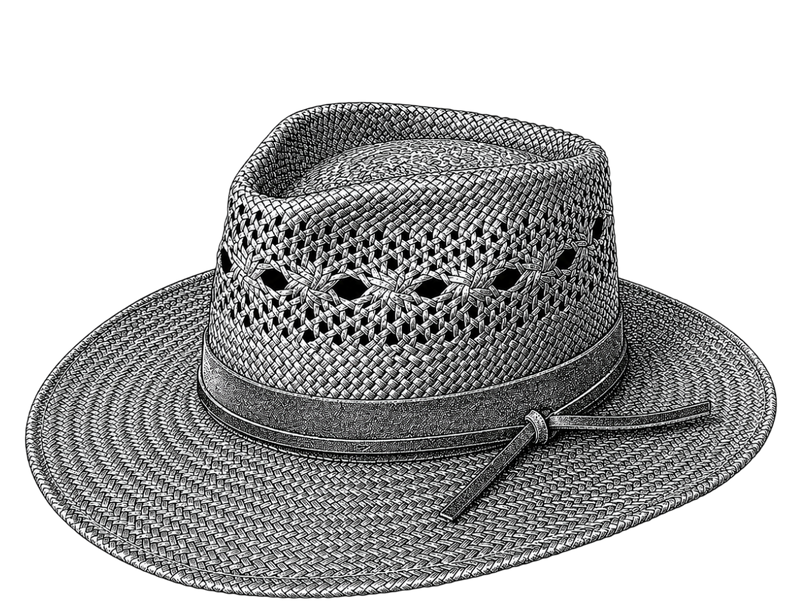
The durability gap between hand and machine stitching isn't about skill alone — it's about stitch tension control and the ability to adapt to material irregularities in real time.
Why Hand-Stitching Holds Up Longer
- Tension adaptability: A skilled hand-stitcher adjusts tension based on material thickness variations; machines apply uniform tension regardless of subtle inconsistencies.
- Reinforcement at stress points: Hand-stitching can add extra passes specifically at high-stress points like brim attachment, where machine stitching follows a uniform pattern throughout.
Insight: Machine stitching's uniform tension is efficient for speed but can over-tighten thinner sections of material or under-tighten thicker ones — inconsistencies a skilled hand-stitcher naturally compensates for during the process.
Practical Trade-Offs
| Factor | Hand-Stitched | Machine-Stitched |
|---|---|---|
| Production speed | Slow | Fast |
| Cost | Higher (labor-intensive) | Lower |
| Stress-point durability | Often superior | Good, but uniform regardless of stress variation |
Bottom line: Hand-stitching's durability advantage comes from adaptive tension control at stress points — a real, mechanical reason for the premium, not just craftsmanship romanticism.
Frequently Asked Questions
How much longer does a hand-stitched brim actually last compared to machine-stitched?
Meaningful difference at stress points, minor difference elsewhere. The brim attachment seam — where the brim joins the crown — is where hand-stitching's tension adaptability matters most. This seam experiences flexing in every direction as the hat is handled, worn, and stored. A well-executed hand-stitched brim attachment can outlast machine stitching at this specific point by years under regular use. On the decorative hatband and non-stress seams, the durability difference is minor.
Can you tell the difference between hand and machine stitching by looking at a hat?
Often, with close examination. Machine stitching is extremely consistent — individual stitches are uniformly spaced and sized. Hand stitching has slight, organic variation in spacing and stitch angle that becomes visible under close inspection or with a loupe. At normal viewing distance both can look identical. The other indicator is seam coverage: hand stitching at stress points often shows additional reinforcement passes or back-stitching that isn't present in machine-stitched construction where the pattern is set and uniform.
Is hand-stitching worth the price premium for everyday hats?
For brim attachment specifically on a hat you wear daily: yes. The brim-crown junction experiences thousands of stress cycles in a year of daily wear. Machine stitching at this point at standard SPI is adequate for 2–3 years; hand-stitched reinforcement at this seam extends that materially. For a hat worn occasionally, the practical difference is much smaller since the cumulative stress is lower. Match the construction investment to your wear frequency.
Related Reading
- Why Stitch Count Per Inch Matters More Than You Think
- The Craftsmanship Behind a Properly Curled Brim
- The Anatomy of a Hat: Every Component Explained
Shop Hatloom
Hats with hand-finished brims and reinforced brim-attachment seams — construction detail disclosed per listing so you know what's holding the brim on.