The pork pie hat is the hat that jazz musicians made an icon, skinheads adopted as a symbol, ska culture reclaimed as its signature, and contemporary fashion keeps rediscovering on a roughly ten-year cycle. It is one of the most specific hat personalities in menswear — immediately recognizable, contextually loaded, and requiring more confidence to wear than almost any other hat style.
Here is what it actually is, where it came from, and how to wear it correctly.
Defining the Pork Pie
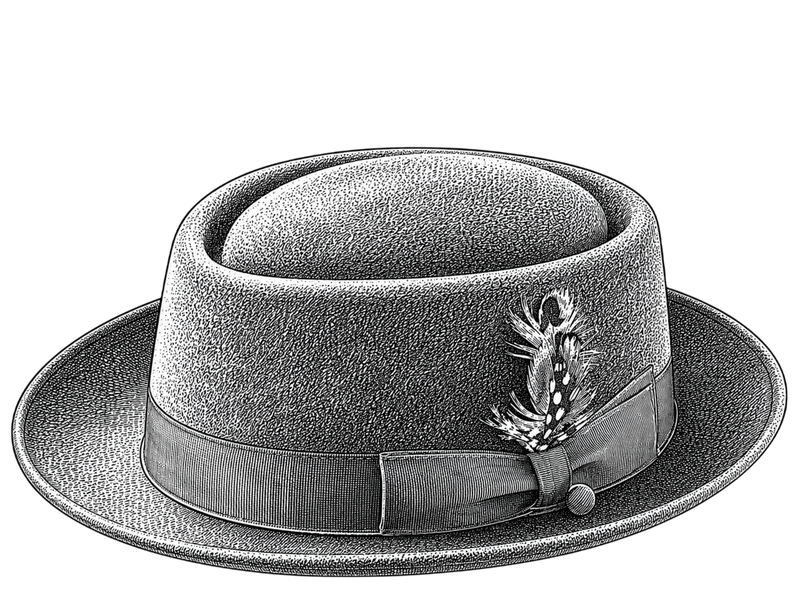
The pork pie has three defining structural features that distinguish it from related styles:
- Flat top: The crown is flat — not rounded, not creased, not domed. The top of the crown is a horizontal flat disc. This is the hat single most distinctive feature and the source of its name, which references the flat-topped circular pastry of the same name.
- Cylindrical or near-cylindrical crown: The sides of the crown are vertical or near-vertical, giving the hat a drum-like shape. Unlike the fedora, which tapers or curves at the crown, the pork pie maintains consistent width from the brim to the flat top.
- Short, turned-up brim: The brim is narrow (3.5–5 cm) and curves upward all around the edge, creating a defined upturned border. The upturned brim angle is shallower than a homburg and more pronounced than a flat hat.
The overall silhouette is immediately recognizable: short, compact, geometric, strong horizontal lines at both the flat crown top and the upturned brim edge.
History: From Victorian Fashion to Jazz Icon
The pork pie hat appeared in British fashion as early as the 1830s, initially as a women hat style. By the mid-19th century it had crossed into men dress as an informal hat alternative to the top hat and bowler. Edward VII was photographed wearing a pork pie in his youth, before the homburg became his signature.
The pork pie maintained a presence in British men dress through the late Victorian and Edwardian eras, then faded as the fedora and flat cap dominated the early 20th century. Its revival came through an unexpected channel: American jazz musicians in the 1940s and 1950s adopted the style as part of a sharply considered aesthetic that functioned as both personal expression and visual differentiation from mainstream culture.
Lester Young — the jazz saxophonist — became the most associated figure with the pork pie hat in this period. Young wore a pork pie as his signature hat so consistently that the association between the style and the man became inseparable in jazz photography. His influence on subsequent jazz musicians spread the style through the culture.
Through the 1960s, the pork pie hat moved into British mod culture and then, critically, into skinhead and later ska subcultures. The two-tone ska movement of the late 1970s and early 1980s — bands including The Specials, Madness, and The Beat — adopted the pork pie as part of a visual language that referenced both Jamaican rude boy style and early 1960s British mod. The pork pie hat became a ska emblem that it has never entirely shed.
Contemporary Context
The pork pie sits at an interesting position in contemporary menswear. It is specific enough to carry all of its accumulated cultural associations — jazz, ska, rude boy, mod — while also being distinctive enough to function as a strong personal style statement independent of those associations for wearers who choose it knowingly.
Fashion houses have included pork pie iterations in collections periodically from the 1990s through the present. Walter White wearing a pork pie in Breaking Bad (2008–2013) created a new cultural association — transformation, moral ambiguity — that added to rather than displaced the hat previous meanings.
Materials and Quality
Pork pie hats are made in wool felt, rabbit felt, and straw (for summer versions). The flat top requires a more rigid felt construction than a fedora to maintain its flat geometry under normal wear — a soft, flexible felt will allow the crown to bow slightly, which undermines the hat defining property.
Quality indicators: the flat top should remain truly flat under light downward pressure. The brim curl should be consistent all the way around with no variation in the upward angle. The geometric precision of the pork pie is its visual claim — inconsistency in either element reads as a construction deficiency.
Who It Suits: Face Shape Guidance
The pork pie is most flattering on faces where the hat angular geometry creates contrast rather than echo:
- Oval faces: The strongest pairing — the oval face carries the pork pie geometric contrast without any proportion concern. The flat top and cylindrical crown work as a strong frame above the oval geometry below.
- Square faces: The flat top echoes the square jaw, which can work as a deliberate geometric statement or read as amplification depending on the specific proportions. A slight visual contrast element — wearing it with a softer outfit, for example — helps.
- Round faces: The short narrow brim of the pork pie does not add useful horizontal width. The cylindrical crown adds vertical emphasis that helps, but the overall effect is less flattering than a fedora with a wider brim on a round face.
- Oblong faces: The flat top potentially adds to the vertical length of an already-elongated face. The short brim does not counterbalance it. The pork pie is among the less flattering styles for oblong faces.
- Heart faces: The narrow brim leaves the wide forehead unbalanced. Better choices exist for heart-shaped faces.
How to Wear a Pork Pie
The pork pie is worn level — the geometric precision of the hat reads best when it sits parallel to the ground without tilting. Its symmetrical geometry makes tilting read differently than with a fedora — where a fedora tilt creates rakish diagonal emphasis, a pork pie tilt reads as the hat being placed incorrectly rather than deliberately.
Outfit register: the pork pie demands a context that supports it. It works strongly in:
- Sharp smart-casual outfits with a distinctive personal aesthetic
- Music-related or creative professional contexts
- Vintage or heritage-influenced dressing that references the hat cultural origins
- Fashion-forward contexts where the statement quality is the point
It does not work in genuinely casual everyday contexts where a less specific hat would be more appropriate, or in formal contexts where the homburg or fedora would be more suitable.
Find distinctive hat styles with strong individual character in the Hatloom collection.
Key Facts at a Glance
- Defining features: Flat crown top, cylindrical crown body, short upturned brim (3.5–5 cm)
- First appeared: 1830s British fashion — initially a women style
- Jazz association: Lester Young, 1940s–1950s — the style most associated figure
- Ska association: The Specials, Madness, The Beat — late 1970s two-tone movement
- Contemporary cultural marker: Walter White, Breaking Bad (2008–2013)
- Best face shapes: Oval and square
Frequently Asked Questions
What makes a pork pie hat different from a fedora?
The pork pie has a flat crown top and a cylindrical crown body with a short, fixed upturned brim. The fedora has a creased or shaped crown (various configurations) with a wider snap-brim that is adjustable in angle. The pork pie is more geometrically rigid and specific; the fedora is more adaptable in shape and more versatile in context.
Why is it called a pork pie hat?
The name references the traditional British pork pie pastry, which has the same flat-topped cylindrical shape as the hat. The name dates from at least the 1860s when the style was establishing itself in Victorian British fashion.
Is the pork pie hat a ska hat?
It is strongly associated with ska culture through the two-tone movement of the late 1970s and early 1980s — The Specials, Madness, and The Beat made the pork pie part of ska visual identity. But the hat predates and extends beyond ska — its origins are Victorian, its primary 20th century association is American jazz, and its contemporary wearing contexts extend well beyond music subcultures.
What face shape suits a pork pie hat?
Oval faces carry the pork pie most naturally — the geometric contrast works without face-proportion concern. Square faces can work with it when the geometric echoing is treated as a deliberate statement. Round and oblong faces are less well-served — the short brim provides no horizontal balance for round faces, and the cylindrical crown can add vertical emphasis to oblong faces.
Can women wear pork pie hats?
Yes — the pork pie works well for women in fashion-forward and androgynous styling contexts. Its geometric strength reads as intentional and confident. Oval and square faces carry it most naturally. The ska and jazz cultural associations are gender-neutral in contemporary fashion contexts.