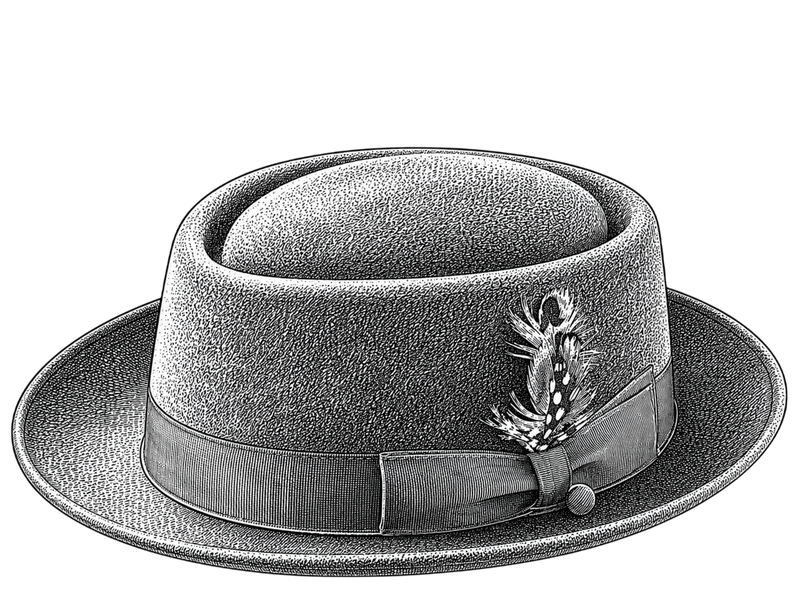
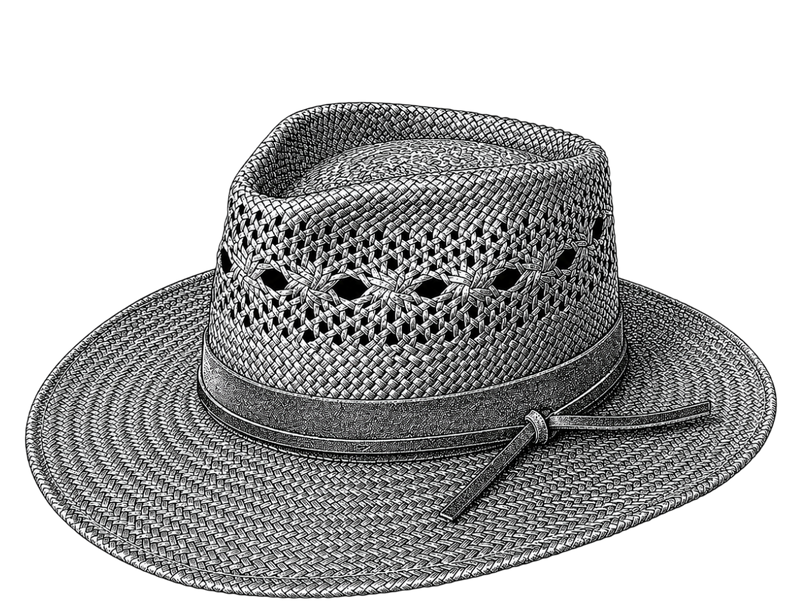
The homburg occupies a specific formal register that most hat discussions skip over. In the formality hierarchy of men's hats, it sits above the fedora and below the top hat -- more structured and formal than a soft felt fedora, less ceremonial than the silk top hat of white-tie occasions. This middle position made it the preferred hat of statesmen, senior businessmen, and formal but not ceremonial occasions for most of the 20th century, and gave it a set of cultural associations (gravitas, authority, conservative establishment) that remain attached to the style today.
What Defines a Homburg
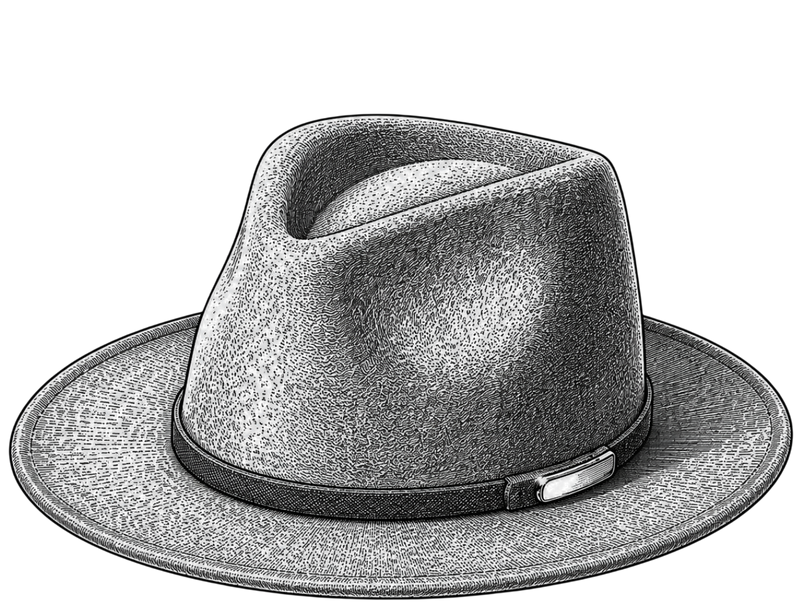
A homburg is a felt hat with specific structural characteristics that distinguish it from the fedora and trilby it is frequently confused with:
- Single central crown crease: the homburg has one lengthwise crease running along the centre of the crown, pressed into a ridge rather than pinched at the front (as the fedora is) or left unpressed (as on the bowler)
- Stiff, slightly upturned brim: the homburg's brim is stiffened and curves upward around its entire edge, creating a consistent upturned profile. A fedora's brim can be shaped in various ways; the homburg's brim has this specific form as a defining characteristic
- Grosgrain ribbon band: a grosgrain ribbon at the base of the crown, typically with a flat bow rather than the more decorative options found on some fedoras
- Firmer felt construction: homburgs are typically made in a firmer felt than soft fedoras, contributing to the more structured and formal appearance

Origins: Bad Homburg and British Royalty
The homburg hat takes its name from Bad Homburg vor der Hohe, a spa town in Hesse, Germany, where the style is said to have been popularised in the 1860s and 1870s. The critical figure in the hat's wider adoption was the Prince of Wales (later King Edward VII of Britain), who visited Bad Homburg and adopted the hat style, bringing it into British royal fashion and from there into the English-speaking world's upper class wardrobe.
Edward VII's advocacy for the homburg was significant because it came with royal authority at a moment when British royal fashion still carried enormous social influence. The hat was adopted by politicians, businessmen, and professionals throughout the late Victorian and Edwardian periods as an alternative to the more formal top hat for occasions that required seriousness without full ceremonial dress.
The Political Hat: 20th Century Associations
The homburg's strongest 20th century associations are with political authority:
- Winston Churchill wore homburgs extensively, contributing to their association with British political gravitas. His preference for the hat was so consistent that photographs of Churchill in a homburg have become iconic images of mid-century British leadership
- Anthony Eden, British Foreign Secretary and later Prime Minister, was so closely associated with the Eden homburg that the hat style was commercially marketed under his name
- Konrad Adenauer, first Chancellor of West Germany, wore homburgs consistently, adding to their Continental European political associations
- In the United States, homburgs appeared in the Eisenhower era in political and business contexts as an alternative to the more casual fedora
This consistent association with senior political and business figures gave the homburg a specific coding: it is the hat of the man in charge, rather than the hat of the active protagonist (the fedora) or the hat of the ceremonial official (the top hat).
The Homburg in Film
Al Pacino's Michael Corleone in The Godfather films wears a homburg in the later films, where Michael has transitioned from an idealistic outsider to the head of the family -- the hat's authority associations make it an appropriate costume choice for a character who has assumed formal power. The homburg appears in other crime and political films in similar authority-figure contexts.
The Homburg Today
The homburg is genuinely uncommon in contemporary everyday dress. Its formality level exceeds what most modern contexts require, and its political associations -- authority, conservatism, establishment -- are not necessarily the associations that most contemporary wearers want to project. The hat has not had the same revival cycles as the fedora, which has benefit from association with Indiana Jones and periodic streetwear reinvention.
The contexts where a homburg makes most sense today:
- Formal occasions with a vintage or period dress code
- High-formality professional contexts (law, finance, certain diplomatic circles) where the hat's authority coding is contextually appropriate
- Deliberate retro or period dressing where the 1940s-1960s aesthetic is the reference
Explore felt hat styles and formal hat options at Hatloom.

Frequently Asked Questions
What is the difference between a homburg and a fedora?
The key differences are the crown crease and the brim. A fedora has a front-to-back crown crease with a pinch at the front (creating the characteristic fedora profile) and a brim that can be shaped in various ways -- up, down, or flat. A homburg has a single central crown crease that runs lengthwise without a pinch, and a brim that curves upward around its entire circumference consistently. The homburg is also firmer and more structured than most fedoras, sitting higher in the formality register. Both are felt hats with grosgrain ribbon bands, and both have similar brim width ranges, which is the source of the frequent confusion between them.
Is the homburg appropriate for a formal wedding?
Yes, and it is more appropriate than a fedora for very formal wedding dress codes. For morning dress (morning coat, waistcoat, and striped trousers), the traditional hat options in order of formality are: top hat (for white tie or the most formal morning dress contexts), homburg (for formal morning dress contexts where the top hat would be excessive), and nothing (for smart but less formally coded weddings). At a formal British-style wedding with a morning dress code, a homburg is a genuinely correct choice. At a contemporary-styled wedding with a dark suit dress code, the homburg may be more formal than the occasion requires.
Why is it called a homburg and not a fedora?
Both names derive from the hat's association with a specific origin story rather than descriptive characteristics. The fedora takes its name from the 1882 play Fedora, where the style appeared in costume. The homburg takes its name from Bad Homburg, the German spa town where it was popularised (at least in popular attribution) and where Edward VII is said to have encountered the style. Both names are proper nouns repurposed as hat category names, which is a common pattern in hat history -- the derby (bowler hat) is named for the Derby races, the trilby for a stage production, the panama for a country it was not made in.