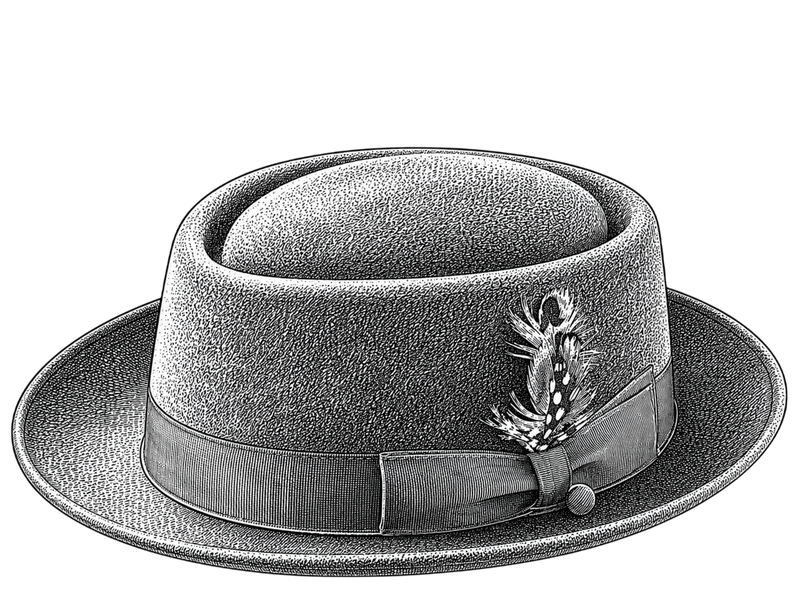
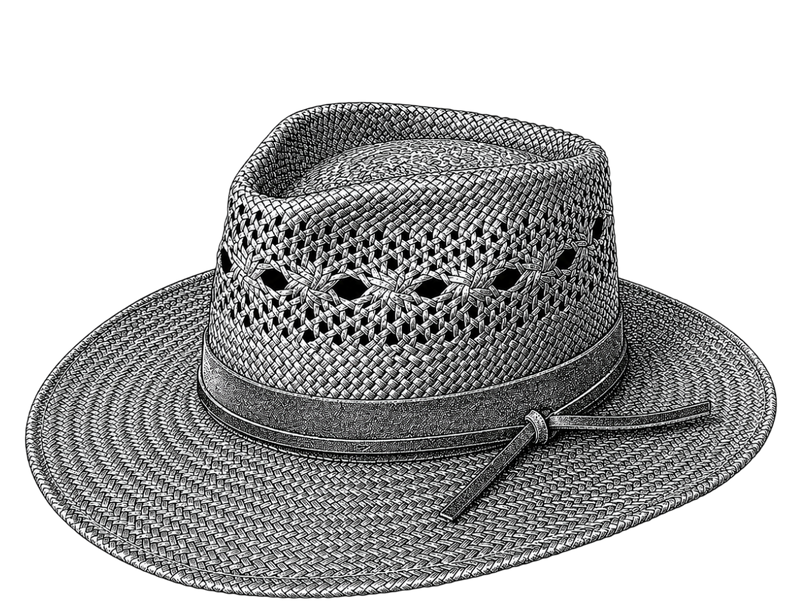
The homburg is the hat that most men know by sight but cannot name. It is the hat Winston Churchill wore. It is the hat Michael Corleone wore in the final scene of The Godfather. It is the hat that sits at the precise intersection of formality and character — more structured and dignified than a fedora, more wearable and less theatrical than a top hat. And it is almost completely absent from contemporary menswear discussion.
This is a mistake. The homburg is one of the most functionally elegant hat designs ever produced.
Defining the Homburg
The homburg is distinguished from related hat styles by three specific features:
- A single center crease: The crown has one deep center crease running front to back. Unlike the fedora, which may have multiple crease variations, the homburg's crown shape is fixed — the center crease is the only crease, and it does not vary.
- A turned-up brim edge: The brim is curved upward at the edges all the way around — not a snap-brim that can be repositioned, but a fixed upward curl that is part of the hat's structure. This upturned brim edge is the most distinctive visual identifier of the homburg.
- A grosgrain ribbon band: A flat grosgrain ribbon around the crown exterior, wider and more structured than the typical fedora band.
The combination produces a hat that is simultaneously formal (the structured fixed shapes) and characterful (the upturned brim gives it a slightly jaunty quality that a top hat does not have).
Origin: Bad Homburg, Germany, 1850s
The homburg takes its name from the German spa town of Bad Homburg vor der Höhe in Hesse. The hat was popularized by Edward, Prince of Wales (later King Edward VII), who encountered it during a visit to Bad Homburg in the 1880s and brought it back to England as a fashionable alternative to the top hat for less formal occasions.
The Royal association gave the homburg immediate social currency in British upper-class society. Within a decade it had become standard formal wear for occasions where a top hat was too formal and a soft felt hat (which the fedora was considered) was too informal — the homburg found its place precisely in that gap.
Key fact: The homburg was the hat of choice for political leaders and statesmen through much of the 20th century. Winston Churchill, Konrad Adenauer, and Anthony Eden all wore homburgs as part of their public personas. The hat carried associations of gravitas, authority, and considered judgment that contributed to its adoption by those who wished to project those qualities.
The Homburg vs. The Fedora: The Precise Differences
The homburg and fedora are the two styles most frequently confused in contemporary menswear. The distinctions are structural and meaningful:
- Crown: The fedora can have multiple crease styles (center dent, cattleman, open crown). The homburg has exactly one configuration — the single center crease. The homburg crown is not adjustable.
- Brim: The fedora has a snap-brim — adjustable in angle. The homburg brim is fixed and permanently turned up at the edges. It cannot be repositioned.
- Formality: The homburg ranks above the fedora in formal contexts. A homburg with a dark suit is appropriate for occasions where a fedora would be acceptable but slightly underdressed. A homburg at a funeral, a formal dinner, or a senior professional context reads as the hat-wearing equivalent of a tie — a signal of formal engagement with the event.
- Adjustability: The fedora's snap-brim is its defining practical feature — it adapts to the wearer. The homburg does not adapt. You adapt to it. This inflexibility is part of its formality — it is a hat with a specific purpose that does not compromise.
Materials and Construction
Quality homburgs are made from wool felt or rabbit felt at mid-range, and fur felt (beaver-rabbit blend) at premium levels. Because the homburg is a formal hat, the material expectations are higher than for a fedora at equivalent price points — a poorly made homburg in cheap felt reads as wrong, where a similar fedora might pass.
The upturned brim requires a stiffer felt or additional brim stiffening to hold its shape through wear and weather. A homburg that loses its brim curl has lost its defining feature — maintaining the brim shape is the primary care consideration specific to this hat style.
When to Wear a Homburg
The homburg is a specialist hat. It is not an everyday casual option — it is the hat for occasions that justify it:
- Formal and business-formal occasions: Dark suit or morning dress contexts. A funeral, a formal dinner, a significant professional event.
- Religious occasions: The homburg has historical associations with formal religious observance in multiple traditions. A black homburg at a formal religious ceremony is contextually precise.
- Creative or fashion-forward contexts: Where the hat is worn as an intentional style statement with a strong personal aesthetic. A charcoal homburg with a well-tailored contemporary outfit is a strong choice precisely because it is not a common one.
The homburg does not work in casual contexts. A homburg with jeans and trainers reads as either ironic (requires substantial conviction and personal style authority to execute) or incongruous. The hat demands outfit match — wear it with something that deserves it.
How to Wear a Homburg
The homburg is less adaptable in positioning than the fedora, but the basic principles apply:
- It should sit 1–2 cm above the ears, with the brim roughly at brow level
- Wear it level — the homburg's fixed geometry does not benefit from tilting and reads as deliberate when worn straight
- The upturned brim provides a natural upward framing to the face — no brim-snapping adjustments needed or possible
Find quality felt fedoras and related formal hat styles in the Hatloom fedora collection.
Key Facts at a Glance
- Origin: Bad Homburg vor der Höhe, Germany, popularized 1880s by Edward Prince of Wales
- Defining features: Single center crown crease, fixed upturned brim edge, grosgrain ribbon band
- Most famous wearers: Winston Churchill, Michael Corleone (The Godfather), Edward VII
- Formality ranking: Above the fedora, below the top hat — the formal hat for occasions requiring gravitas without full ceremony
- Brim type: Fixed upturned edge — unlike the snap-brim fedora, not repositionable
Frequently Asked Questions
What is the difference between a homburg and a fedora?
The homburg has a single fixed center crease in the crown and a permanently upturned brim edge — neither is adjustable. The fedora has multiple possible crown crease styles and a snap-brim that can be repositioned in multiple configurations. The homburg is more formal and less adaptable; the fedora is more versatile and casual-compatible.
Who made the homburg famous?
Edward, Prince of Wales (later King Edward VII) popularized it in Britain in the 1880s after encountering the style in the German spa town of Bad Homburg. Winston Churchill, who wore a black homburg consistently through his political career, became the hat most identified image in the 20th century. The Godfather (1972) reinforced the association with formal authority in American popular culture.
Is a homburg appropriate for a funeral?
Yes — a black or dark charcoal homburg is one of the most contextually appropriate hat choices for a formal funeral, particularly when worn with a dark suit. It reads as formal respect without overstatement. Remove during the service at key ceremonial moments consistent with the tradition being observed.
Can I wear a homburg casually?
It requires significant personal style conviction to wear a homburg in genuinely casual contexts — the hat formal geometry reads as incongruous with casual clothing in a way that the more adaptable fedora does not. Some strong-identity dressers make it work; for most wearers, the homburg is a formal-occasion hat rather than an everyday one.
What color homburg is most versatile?
Black is the most formal and context-appropriate color for occasions where a homburg is specifically correct (funerals, formal dinners). Charcoal or dark grey is more versatile — appropriate for formal and business-formal contexts without the funerary specificity of black. Camel or mid-tan is the most contemporary option for fashion-forward wearing outside strictly formal contexts.