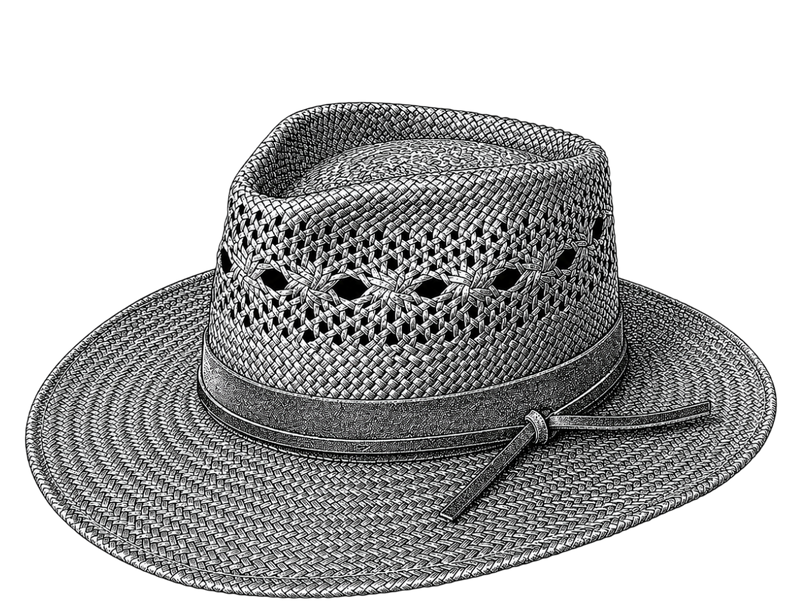
The floppy hat is defined by what it does not do: the brim does not hold a rigid shape. This might seem like a limitation, but it is actually the design feature that creates the hat's specific visual appeal and practical advantages. A soft, downward-draping brim creates different light and shadow patterns than a stiff horizontal brim, packs and travels more easily, and has a visual character -- relaxed, romantic, slightly undone -- that rigid hat styles cannot replicate regardless of how wide their brim is. The floppy hat's softness is its product, not its compromise.
What Makes a Hat 'Floppy'
The floppy hat category is defined by brim behaviour rather than a specific hat style name. A floppy hat is one where the brim is made from soft, unstructured material that drapes under its own weight rather than holding a rigid horizontal position. This can be achieved through:
- Material choice: soft straw (raffia, paper straw, loosely woven natural fibres) that bends and drapes rather than holding a stiff position; soft felt that has not been stiffened; lightweight cotton, linen, or canvas without interfacing
- Construction: absence of internal wire, boning, or stiffening treatment in the brim
- Width: a wider brim is more likely to drape by its own weight even in moderately stiff materials; a narrow brim in the same material may hold its shape while a very wide brim of the same material droops

The Visual Character of the Floppy Brim
The floppy brim creates specific visual effects that rigid brims do not:
- The draping brim creates changing shadow patterns as the hat moves -- the brim responds to head movement and air movement in a way that a stiff brim does not, creating subtle visual interest
- The irregular, slightly unpredictable shape of a floppy brim is visually distinct from the engineered precision of a structured hat, which creates an aesthetic that references handmade craft, natural materials, and relaxed elegance rather than manufactured precision
- The same floppy hat will look slightly different on different wearers because the way the brim drapes responds to how it is placed on the head and how it falls relative to the face -- there is inherent individuality in the floppy hat that structured hats do not provide
The Fashion History
Soft, wide-brimmed hats for women have recurred in fashion history at regular intervals, most commonly in contexts that reference romanticism, bohemianism, or outdoor leisure:
- Late 19th century: wide-brim soft straw hats appeared in impressionist paintings of leisure scenes -- Renoir and Monet both depicted women in wide-brim soft hats that read as the visual shorthand for relaxed upper-class outdoor life
- 1970s: the floppy wide-brim hat in felt, straw, and fabric was closely associated with the bohemian and hippie aesthetics of the era. The wide floppy hat was part of the 1970s romantic-pastoral dressing that included maxi skirts, prairie dresses, and natural fabrics
- 1990s-2000s: the wide-brim floppy hat appeared in festival fashion and beach dressing, establishing an association with music festivals and beach holidays that persists in current fashion imagery
- 2010s-present: the floppy wide-brim hat has been a consistent seasonal item in fashion across the years, appearing in sun-protective and beach-focused collections as well as in broader fashion editorial contexts
Sun Protection Notes
The floppy hat's sun protection performance requires qualification. A wide, drooping brim provides sun protection for the face that tracks where the brim is actually positioned -- which changes as the brim moves. A floppy brim that droops to shade the cheeks and ears on one side may not be providing the same shade on the other side. For consistent, controlled sun protection, a structured rigid brim in the correct width is more reliable than a floppy brim of the same width.
That said, a floppy hat with a wide enough brim (10+ cm) provides substantial overall sun protection even with the inconsistency of brim positioning -- it will shade most of the face most of the time, and the portions of the brim that are shading effectively are providing complete (100%) UV protection for the areas underneath them. The floppy hat is a reasonable sun protection tool, not an ideal one.
How to Wear a Floppy Hat
The floppy hat's placement affects its visual character significantly:
- Worn level on the head at the standard position (2-3 cm above the eyebrows), the floppy hat frames the face with the drooping brim creating a canopy effect
- Worn pulled down slightly at the front, the brim shades the face more dramatically and creates a more mysterious, face-obscuring effect
- Worn tilted to one side, the brim creates an asymmetric silhouette that adds visual interest and provides more shade to one side
- Worn pushed back on the head, the floppy brim creates a different character -- less sun protection but more visible face and more of a casual, straw-hat-at-the-beach visual
Browse floppy straw hats, wide-brim sun hats, and soft-brim styles at Hatloom.

Frequently Asked Questions
Are floppy hats good for sun protection?
Yes, with the qualification that a floppy brim provides inconsistent shade coverage compared to a rigid brim of the same width. A very wide floppy hat (12+ cm brim) provides significant overall sun protection for the face because the brim is wide enough that even with movement and draping, most of the face is shaded most of the time. For sustained outdoor exposure in high UV conditions, a structured wide-brim hat with a UPF rating provides more reliable and measurable protection. For casual beach and outdoor use where consistent shade coverage is desired but not critical, a wide floppy hat is adequate.
Can men wear floppy hats?
Yes. The floppy wide-brim straw hat has traditionally been more associated with women's fashion, but wide-brim straw and fabric hats for men in outdoor and beach contexts are entirely conventional. A wide-brim straw hat in a natural colour for beach and outdoor use is a gender-neutral functional item. More fashion-forward interpretations of the floppy hat in menswear appear in festival, streetwear, and international fashion contexts. The association with women's fashion is strongest in formal and fashion editorial contexts; in outdoor and beach contexts, the wide soft-brim hat has no strong gender coding.
How do I keep a floppy hat from losing its shape?
Floppy hats are designed not to hold a rigid shape, so 'losing shape' in the sense of brim deformation is inherent to the style. What can be prevented is uneven deformation -- a brim that folds and creases in one place consistently, or a crown that collapses asymmetrically. Prevention measures: store a floppy hat on a hat stand or with the crown stuffed with tissue paper to maintain the crown shape; when traveling, pack a floppy hat with clothing wrapped around the crown to cushion it rather than folding it flat. If the hat's brim has developed a persistent unwanted fold, a brief exposure to steam and gentle manipulation while the material is warm can partially reset the brim position, though the floppy material will continue to drape freely.