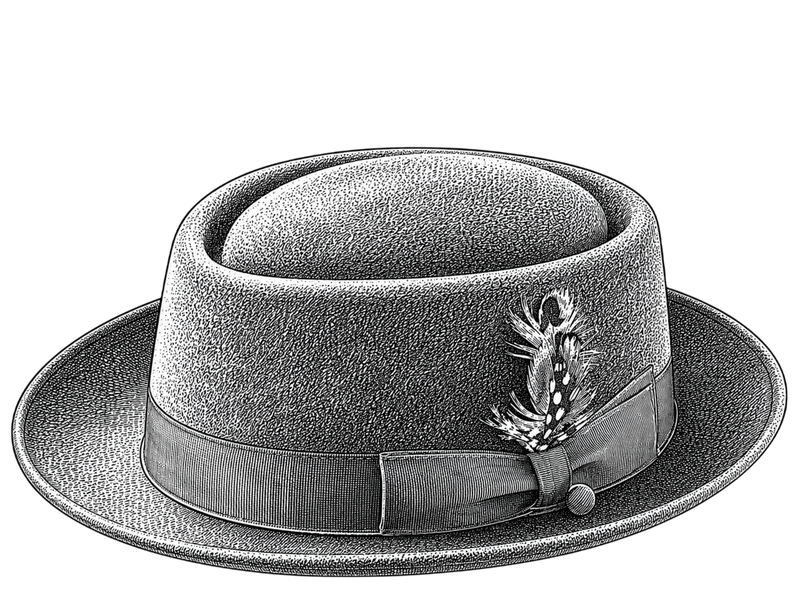
The tall, cylindrical black hat with a narrow brim and a flat or slightly conical crown -- instantly associated with Pilgrims, Puritans, and a specific image of 17th-century religious austerity -- has a name that almost no one knows: the capotain. Understanding what it actually was, who wore it, and why it looks the way it does requires correcting several of the most persistent misconceptions in hat history.
What a Capotain Is
A capotain (also spelled copotain, copitain, or capatain) is a tall-crowned hat with a moderately narrow brim, a roughly cylindrical or slightly conical crown, and a flat or rounded top. It is typically depicted in black felt, though historical examples were made in various dark colours. The hat was the dominant formal hat style across much of Northern Europe in the late 16th and early 17th centuries -- it was worn by men of many professions and economic levels, not exclusively by religious groups.
The association with Puritans and Pilgrims is accurate in the sense that Puritan communities did wear capotains, but it is incomplete: the capotain was fashionable civilian dress across Tudor England and into the early Stuart period. It was not an invention of religious austerity but a mainstream fashion that religious communities wore because it was what men of their time and location wore.
Origins and Fashion Context
The capotain developed in the mid-16th century from earlier medieval hat forms. It became fashionable in England and the Netherlands from approximately the 1570s onward, achieving its peak in the 1580s-1620s. It appears in portraits of the period across the socioeconomic spectrum -- from merchant classes to minor nobility. The hat is not an exclusively English form: similar tall-crowned hats appear in Spanish, French, and German portrait painting of the same period, though the English and Dutch versions are the most consistently depicted.
The hat's height varied. Earlier versions tended toward taller, more dramatically conical crowns; later versions in the early 17th century had somewhat lower, more cylindrical crowns. The brim could be flat or slightly rolled upward at the edges. Decorating the hat with a hatband, buckle, or ribbon was common in fashion-conscious wear; the undecorated versions typically appear in portraits where the sitter is emphasising religious simplicity.

The Pilgrim Association and American History
The Pilgrims who arrived at Plymouth, Massachusetts in 1620 were English Separatist Puritans wearing the standard dress of their period and background -- including capotain hats for men. The hats were not a statement of religious identity; they were the ordinary formal hats of early 17th-century Englishmen. The subsequent association of the capotain with Puritan religious identity was a retrospective identification -- later artists depicting the Pilgrims used the capotain as a visual shorthand for their 17th-century origin, and the hat became associated with Puritan identity through this artistic tradition rather than through contemporary significance.
American Thanksgiving iconography has made the black capotain (combined with a white collar and buckled shoes) one of the most recognisable historical costume elements in North American culture. This image is substantially a 19th-century construction of 17th-century appearance, with some details (the buckled hat band, the all-black palette) that were probably not as uniform as depictions suggest.
The Capotain's Influence on Later Hat Design
The capotain's tall, structured crown was the direct ancestor of the top hat. The evolution from the capotain through the 17th and 18th centuries -- with the crown gradually evolving from the conical capotain form toward the cylindrical stovepipe and eventually the standard top hat profile -- is visible in portrait sequences from the period. The logic of a tall structured crown as formal male headwear was continuous from the capotain period through the top hat's dominance in the 19th century.
The capotain also influenced the development of the witch hat in costume and theatrical tradition -- the tall conical black hat associated with witches in popular imagination shares the capotain's basic silhouette and likely derives from the same period's fashion.
Explore the full history of hat styles and their modern descendants at Hatloom.
Frequently Asked Questions
Did Puritans actually always wear black?
No. The image of Puritans as uniformly dressed in black is largely a 19th-century artistic convention. Contemporary portraits and records indicate that Puritan communities wore dark colours (navy, dark brown, dark green, charcoal) as well as black, and that the preference for modest colours did not preclude colour variation. White was prominent in collars and cuffs. The all-black palette of the stereotypical Puritan costume is a simplified artistic shorthand rather than an accurate period representation.
What is the difference between a capotain and a stovepipe hat?
The stovepipe hat is a later development -- a very tall, cylindrical hat with an absolutely flat top, popular in the late 18th and early 19th centuries (Abraham Lincoln's hat is the most famous stovepipe reference). The capotain has a slightly conical crown that narrows or is rounded at the top, while the stovepipe has a strictly cylindrical crown of uniform width from base to flat top. The capotain also generally has a wider brim relative to its crown height than the stovepipe. Both are tall formal hat forms, and the stovepipe represents the later evolution of the tall-crown formal hat tradition that the capotain was part of.
Where can I see actual historical capotain hats?
Physical surviving examples of capotain hats are very rare because the felt material of the period has not survived well over 400 years in most conditions. The most reliable visual record is portrait painting: museum collections with strong Tudor and early Stuart English portrait holdings -- including the National Portrait Gallery in London, the V&A, and US collections with early Colonial American portraits -- provide primary visual documentation. Costume historians at major museums have also reconstructed capotains for research purposes; their reconstruction notes often provide the most technically detailed information about construction methods.
Was the capotain only for men?
In its tall-crowned formal version, the capotain was primarily men's headwear. Women's headwear in the same period was dominated by different forms -- coifs (close-fitting linen caps), veils, and increasingly in the later 16th century, headwear that reflected the Continent's influence (French hoods, Italian-influenced forms). However, women of the period did wear various hat-like coverings outdoors, and some portrait evidence shows women in brimmed hats with lower crowns than the capotain. The specific tall-crowned capotain form is predominantly documented in men's wear of the period.