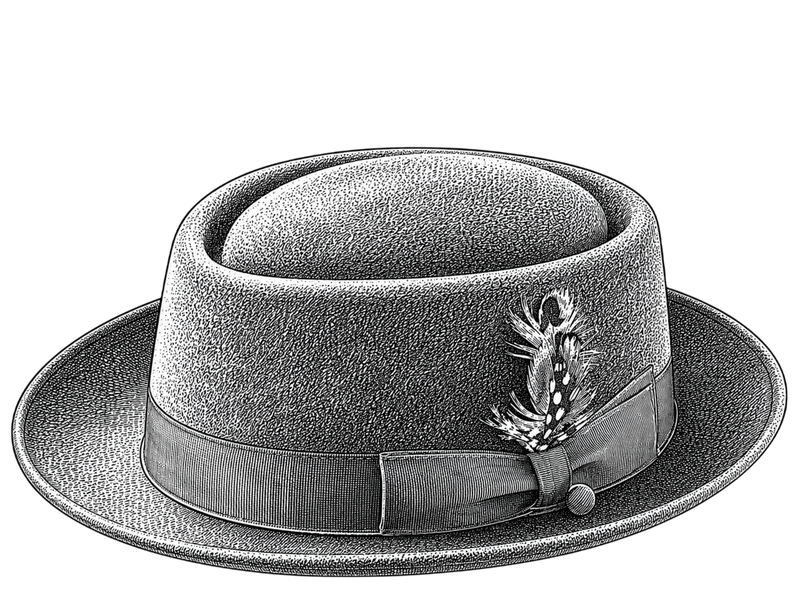
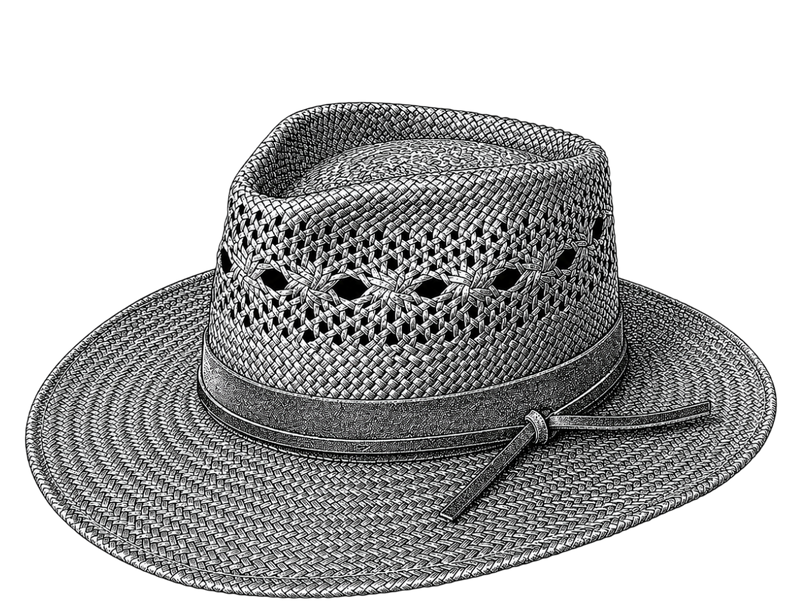
The boater hat reached peak cultural saturation in the 1890s and has never fully left. Every generation rediscovers it as a novelty — then realizes it was never actually gone. A flat-topped, flat-brimmed straw hat with a grosgrain ribbon band: the design is so resolved that no one has found a reason to improve it in 130 years.
What Defines a Boater Hat
A boater is distinguished from other straw hats by four specific structural characteristics:
- Flat crown: The crown top is a rigid horizontal plane, not rounded, pinched, or domed. The flat crown is the signature element — without it, the hat is a different style.
- Flat brim: The brim is horizontal and uniform in width, typically 2–3 inches, with no curl or upturn.
- Stiff construction: Boaters are made from sennit straw — a braid of dried grasses pressed and shaped into a rigid structure. Unlike floppy straw hats, a boater holds its shape absolutely. It does not collapse, roll, or flex.
- Grosgrain ribbon band: A grosgrain ribbon (ribbon with a ribbed texture) encircles the base of the crown. In institutional contexts — schools, rowing clubs, barbershop quartets — the ribbon carries stripes or emblems that identify the group. In everyday wear, the ribbon is typically solid black or navy.
The History of the Boater Hat
The boater emerged in the 1880s as a practical warm-weather hat for outdoor activities near water — rowing, punting, seaside leisure. The stiff sennit straw construction made it lighter and more breathable than the felt alternatives of the era, while the rigid structure gave it a clean, presentable silhouette appropriate for the semi-formal outdoor occasions of Victorian leisure culture.
By the 1890s, boaters were standard warm-weather headwear across class lines. Factory workers wore them for practical ventilation. Gentlemen wore them for weekend leisure. Schoolboys wore them with institutional ribbons identifying their school. The British still associate the boater most strongly with Eton College and Henley Royal Regatta, where it remains part of the visual identity of both institutions.
The boater peaked between 1900 and 1930. American vaudeville performers and barbershop quartets adopted it as a performance hat, which embedded it in American popular culture as a symbol of a specific era of entertainment. By the 1940s, as hat-wearing generally declined, the boater retreated to institutional and specialty contexts.
It has been revived periodically by fashion — most significantly in the 1960s British mod scene and in 1970s menswear — and has maintained a low-level continuous presence in warm-weather style ever since. Current interest in heritage menswear and vintage styling has renewed serious attention to the boater as a summer hat with genuine historical credibility.
How to Wear a Boater Hat
The Fundamental Rule: Wear It Level
A boater is worn level on the head — neither tilted back nor pulled down at an angle. The flat brim sits parallel to the ground. This is not optional: the boater silhouette only works when the flat geometry of the crown and brim is presented at its correct angle. A tilted boater looks like a mistake rather than a style choice.
The hat sits 1–2 finger-widths above the eyebrows. Lower than this, and the flat crown looms. Higher, and the hat appears to float rather than sit on the head.
With What to Wear It
Classic pairings (historically correct):
- Seersucker suit in navy or gray — the boater is the historical finishing piece for summer seersucker
- Linen trousers and a striped shirt — the continental warm-weather reference
- Blazer with brass buttons and white trousers — nautical, appropriate for regatta contexts
Contemporary pairings (modern interpretations):
- Light-wash denim and a white linen shirt — the boater reads as a considered accessory against casual fabrics
- A simple summer dress — the structural contrast of the rigid boater against soft draping fabric is the point
- Wide-leg trousers in a natural fiber — part of current heritage-informed warm-weather dressing
Face Shapes and the Boater
The boater works best on oval and oblong faces, where the geometric regularity of the flat crown and brim complements balanced proportions. Round faces are challenged by the boater: the rigid horizontal brim can accentuate width rather than mitigating it. Choosing a slightly wider brim (3 inches rather than 2) and wearing the hat precisely level — not pulled down — helps. Heart and diamond faces handle the boater well, as the horizontal brim broadens the apparent jaw width.
The Ribbon: Style Variable
The grosgrain ribbon is the primary style variable within a boater design. Standard options:
- Solid black or navy: The most versatile. Works with everything. The choice when you want the hat to recede into the outfit rather than make a statement.
- Regimental stripe (navy and red, or club-specific colors): The traditional British version. Has strong institutional associations that some wearers find appealing and others find affected.
- Wide solid ribbon in an accent color: A more casual, contemporary interpretation. A cream or tan ribbon on a natural straw hat reads as summery and relaxed rather than formal.
The ribbon can be replaced — many boater wearers switch ribbons seasonally or to match specific outfits. The ribbon is typically attached with a pin at the back, making it more replaceable than it appears.
Care for a Stiff Straw Boater
Sennit straw is rigid but brittle. Unlike floppy straw hats, a boater cannot be compressed, rolled, or sat on and reshapen. Physical pressure against the crown or brim can crack the straw construction permanently. Store flat on a shelf or on a wide hat stand — not stacked, not on a peg that contacts the crown.
Moisture is the primary weather concern. A light rain will not damage a boater, but sustained wetting can soften the sennit braid and compromise the structural rigidity that defines the hat. Dry immediately after exposure to moisture, away from direct heat.
Surface dust is removed with a soft brush or dry cloth, working with the direction of the straw braid. Do not use liquid cleaners on natural sennit straw.
Explore boater hats and structured summer straw styles in the Hatloom straw hat collection.
Frequently Asked Questions
What is the difference between a boater hat and a Panama hat?
The boater and the Panama share straw construction and warm-weather use, but they are structurally opposite. A boater has a rigid flat crown and flat brim — its defining quality is geometric rigidity. A Panama has a rounded, often pinched crown and a flexible brim that can be shaped to personal preference. The Panama is a softer, more adaptable hat; the boater is an architectural object with essentially no flexibility. Panama hats are made from toquilla straw from Ecuador; boaters are typically made from sennit braid.
Are boater hats still worn today?
Actively. Boaters appear in current warm-weather menswear and womenswear, particularly in heritage-informed and preppy-adjacent styling. They remain part of the institutional dress code at Eton College and Henley Royal Regatta. In fashion, they have appeared in recent collections from brands interested in archival British style. They are not mainstream everyday headwear, but they are not historical artifacts — they are functioning style items with a clear and coherent contemporary application.
What occasions suit a boater hat?
Outdoor summer events — garden parties, regattas, races, seaside occasions, outdoor weddings. Also appropriate for summer city dressing in the same contexts that suit a linen suit: the hat carries the same formality temperature as lightweight summer tailoring. Less appropriate for casual everyday wear, where its strong silhouette reads as a statement rather than simply a hat.
How do I know if a boater hat fits correctly?
A correctly fitted boater sits snugly on the head without requiring adjustment — it should not move when you shake your head moderately. The brim should sit level. The sweatband should contact the head fully without significant gaps or pressure points. Because the boater has no adjustable elements, precise hat sizing is more important than with flexible straw hats that can be pinched or rolled to adjust fit.
Can women wear boater hats?
The boater has a long history of wear by both men and women — the rigid geometric silhouette has been adapted across multiple decades of women's fashion, particularly in the Edwardian period and again in the 1960s. Contemporary women's boater styling typically pairs the hat with lightweight summer dresses or wide-leg trousers, using the structural contrast between the rigid hat and softer clothing as the point of interest. The same wearing rules apply: level on the head, 1–2 finger-widths above the eyebrows.