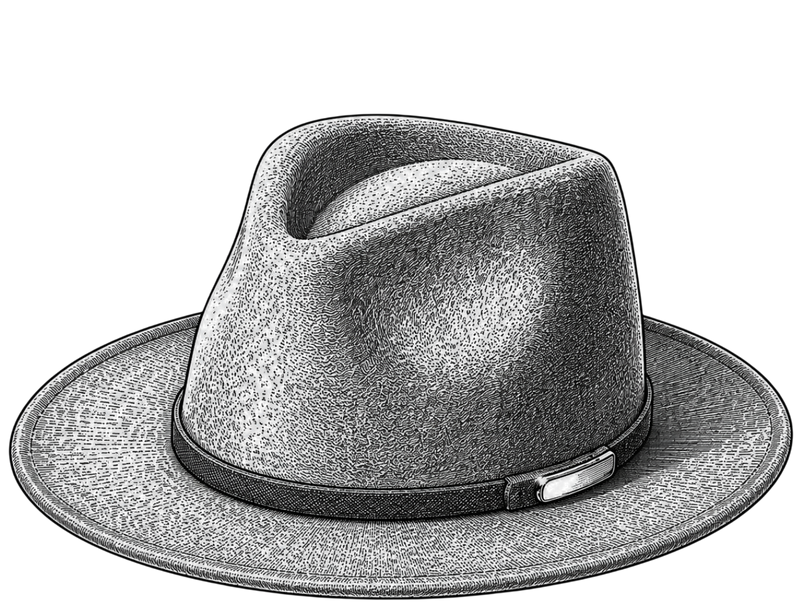
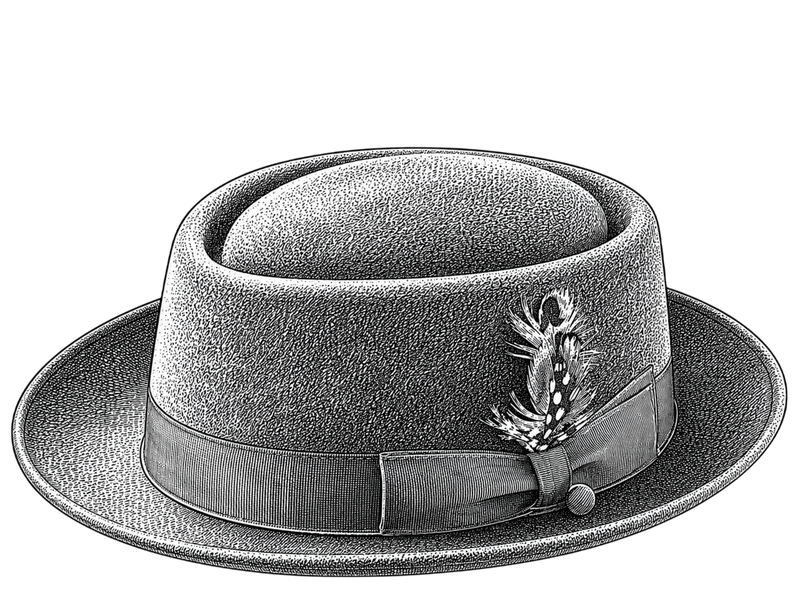
Vintage hat collecting is one of the few areas of wearable collecting where acquisition cost and quality are frequently inversely related. A deadstock felt hat from the 1950s found in an estate sale for $30 may be a superior object — in material, construction, and condition — to a $200 reproduction made today. The knowledge required to identify that gap is the entire value of developing expertise in the field.
Why Vintage Hats Are Worth Collecting
Three material arguments, not nostalgia:
- Material quality that no longer exists at accessible prices: Mid-century felt hats were made from fur felt — rabbit and beaver blends — as a standard, not a premium. The same quality of material in a new hat today costs $300+. Vintage fur felt hats from the 1940s–1960s frequently appear at estate sales and antique markets for $20–$80.
- Construction standards from pre-automation era: Handblocked hats from the mid-20th century have construction details — hand-stitched sweatbands, correctly tensioned brim binding, carefully shaped crowns — that machine production cannot consistently replicate. The craftsmanship evidence is visible in the finished object.
- Unique shapes and proportions no longer in production: Hat shape conventions have changed significantly since the 1940s–1960s. Wider brims, taller crowns, and specific crease styles that were standard in mid-century production are not being made today. Vintage hats provide access to proportions that are genuinely unavailable as new production.
Where to Find Vintage Hats
Estate Sales
The best source for undiscovered quality pieces at low prices. Estate sales liquidate the possessions of deceased individuals — including hats stored in hat boxes, sometimes unworn, from decades past. Hat boxes are a strong indicator at estate sales: a round hat box almost always contains a structured hat worth examining.
Search estate sale listings in your region through dedicated estate sale websites. Arrive early — quality pieces at accessible prices move in the first hour. Focus on sales from older properties where mid-century possessions are more likely to be present.
Antique Fairs and Flea Markets
Higher foot traffic and more curation than estate sales, which means higher prices — but also more accessible examination of multiple pieces simultaneously. Good for developing eye for quality and condition assessment. Prices are negotiable at most antique fairs; bring knowledge of what you are looking at to inform offers.
Online Auction Platforms
The broadest selection available globally, but with significant condition uncertainty. Photographs rarely capture the full condition picture of a hat — staining, odor, structural damage, and sizing are all difficult to assess from images. Reserve online purchases for either clearly identified pieces from knowledgeable sellers or lower-priced acquisitions where condition uncertainty is an acceptable risk.
Search terms that produce results: the manufacturer name (Stetson, Borsalino, Mallory, Dobbs, Adam, Knox), the material (fur felt, beaver felt, quality felt), the decade, and the style (fedora, homburg, western, derby).
Hat Specialists and Vintage Dealers
Specialist dealers who focus on vintage hats provide condition-assessed pieces with higher confidence but at higher prices. The value is in the knowledge — a specialist who says a hat is in excellent original condition has examined it in ways a general estate sale buyer cannot. Worth the premium for significant acquisitions.
Condition Assessment: What to Check
Condition is the primary quality variable in vintage hats. A great hat in poor condition is a worse acquisition than a good hat in excellent condition.
Sweatband
The sweatband deteriorates fastest and is often the first indicator of overall hat condition. Check for:
- Cracking, peeling, or disintegration of leather bands
- Staining on grosgrain ribbon bands
- Odor — a persistent odor indicates moisture exposure and possible mold
- Legibility of the manufacturer label — intact labels add value and information
A deteriorated sweatband is replaceable. A severely stained or odorous one may indicate that the damage has migrated to the outer felt.
Felt Surface
- Nap condition: Run your hand across the felt surface. A smooth, consistent nap indicates good condition. Bald patches, rough texture, or fiber pilling indicate damage or heavy wear.
- Moth damage: Small holes or thinned areas in the felt indicate moth larvae damage. Any such damage is structural and cannot be fully repaired.
- Staining: Surface stains on the crown — particularly in the side panels and at the crease of the crown — are common and often treatable. Stains that have penetrated through the full thickness of the felt are more difficult to address.
- Color fading: Uneven fading, particularly on the top of the crown from UV exposure, affects appearance but not structural integrity.
Brim
- Check the brim edge — look for fraying, separation of binding, or cracking at the edge
- Check brim shape consistency — a brim that has been stored flat, curled, or otherwise distorted may have taken a permanent set that cannot be fully corrected
- Feel the brim stiffness — a brim that has lost its stiffener will flex too easily; one with dried or cracked stiffener may crinkle
Crown Shape
Most vintage hats can be reshaped with steam if they have developed dents or distortion during storage. The exception is creases that have been set over decades — a hat stored with a deep pressure crease in the crown may retain that crease even after steaming. Assess whether existing shape issues are resolvable before purchase.
Key Manufacturers Worth Knowing
Certain manufacturers produced consistently high-quality hats through the mid-20th century. Their labels in vintage hats indicate quality above market average at equivalent prices:
- Stetson (US): The defining American hat manufacturer. Mid-century Stetsons in quality felt grades are excellent acquisitions. Look for grade designation on the interior label.
- Borsalino (Italy): The benchmark Italian hat maker, producing continuously since 1857. A Borsalino label in a vintage hat indicates the highest available quality. Still in production today.
- Mallory (US): Mid-century American manufacturer known for quality fur felt. No longer operating — vintage pieces are the only access to the label.
- Dobbs (US): Quality mid-century American maker associated with Madison Avenue and professional-class dress. Strong construction and material quality.
- Christys (UK): British manufacturer operating since 1773. Vintage Christys hats in quality felt represent exceptional British craftsmanship. Still operating today.
Restoration Basics
A vintage hat in good structural condition but needing restoration can often be brought to excellent wearable condition with relatively simple techniques:
- Reshaping: Steam and gentle hand reshaping, or professional re-blocking by a milliner with the correct hat block for the style and size
- Cleaning: Soft brush for surface dust, targeted spot cleaning for stains (following the method appropriate to the stain type — see the felt cleaning guide)
- Sweatband replacement: A new leather or grosgrain sweatband can transform an unwearable hat into a daily wearer. $15–$40 professionally done.
- Band replacement: The decorative exterior ribbon can be replaced if faded or damaged — grosgrain ribbon is available in standard hat widths
Avoid restoration attempts on significant or high-value pieces without professional assessment. An incorrectly attempted restoration can reduce value and condition.
Find modern hats that honor mid-century quality and construction in the Hatloom collection.
Frequently Asked Questions
Where is the best place to find quality vintage hats?
Estate sales offer the best potential for high quality at low prices — fur felt hats from the 1940s–1960s appear regularly at estate sales from older properties. Antique fairs provide more curation and easier comparison. Online auction platforms offer the widest selection with the highest condition uncertainty. Specialist vintage hat dealers provide the best condition assessment at higher prices.
How do I know if a vintage hat is quality?
Check the manufacturer label — known quality makers (Stetson, Borsalino, Mallory, Dobbs, Christys) are reliable indicators. Feel the felt — quality fur felt is denser, smoother, and more tightly structured than wool felt. Check for hand-stitching details in the sweatband and brim binding. A hat with intact manufacturer documentation and legible label in a recognized quality brand is the safest vintage quality indicator.
Can vintage felt hats be worn, or are they just for display?
Quality vintage felt hats in good condition are fully wearable — the material does not degrade significantly with age when stored correctly. Vintage fur felt hats are often superior to equivalent new wool felt hats in density, water resistance, and surface quality. Many serious hat wearers specifically seek vintage fur felt for its wearing qualities, not just its history.
How should I care for a vintage hat I plan to wear?
Inspect and clean before first wear. Replace the sweatband if deteriorated — this is the most common maintenance need for vintage hats. Reshape any stored distortion with steam and a hat stand. Apply a light water-repellent spray for outdoor use. Store on a hat stand or in a hat box between wears — exactly as you would a new quality hat. Vintage hats do not require special care beyond what any quality felt hat needs.
What is a deadstock vintage hat?
A deadstock hat is one that was manufactured but never sold or worn — it has been in storage since production, often still in the original hat box with tags intact. Deadstock vintage hats represent the highest condition category — original shape, no wear, often with original manufacturer packaging. They appear at estate sales when old stock from hat shops or warehouses is discovered. The price premium over worn-condition vintage is significant — a deadstock quality hat may command 3–5x the price of the same hat in good worn condition.