The Stetson is not just a hat style -- it is the first American hat brand with national cultural reach, and the story of how John B. Stetson created and then defined an entire hat category is one of the more unusual business and design histories in American manufacturing. Understanding the Stetson requires understanding what hat problem it was designed to solve, and why that solution became an American symbol.
The Origin: John B. Stetson and the Boss of the Plains
John Batterson Stetson (1830-1906) was not a professional hatter by background -- he was a New Jersey-born hat maker who travelled to the American West in the 1860s for his health (he had tuberculosis) and observed that the hat options available to Western workers were inadequate for the conditions. Eastern hats -- bowlers, tall-crown felt hats -- did not handle sun, rain, wind, and rough use in ways that the Western environment required.
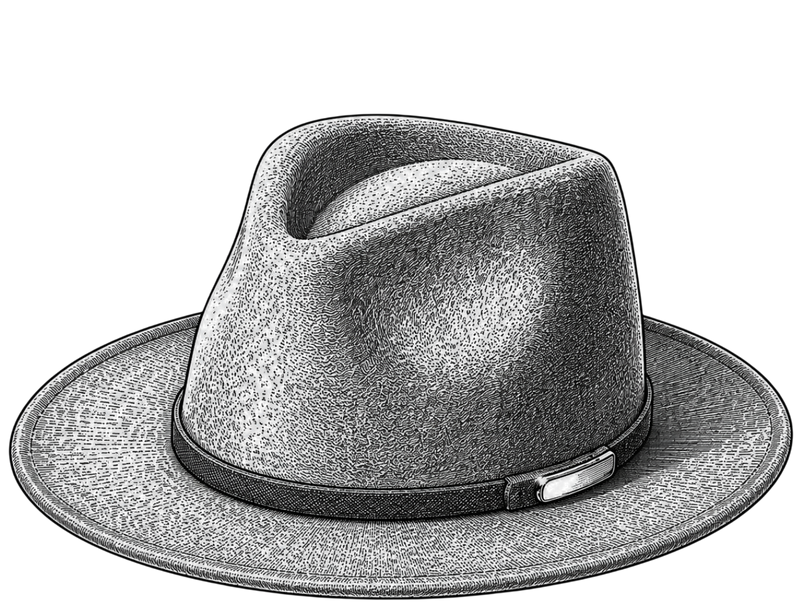
In 1865, Stetson established his Philadelphia hat company and produced what became the Boss of the Plains: a flat-brimmed, straight-sided, natural tan felt hat with a significant brim width (approximately 4 inches / 10 cm) and a plain open crown. The hat was constructed from fine fur felt, which was water-resistant, flexible, and durable. He sent samples to Western dealers and the hat sold immediately and continuously.
Within a decade, the Boss of the Plains had become the dominant hat of the American West -- worn by cowboys, lawmen, soldiers, and settlers. The hat was functional enough to justify its cost over the alternatives, and it became the visual shorthand for Western American identity that it remains today.

What Made the Stetson Construction Different
The Stetson's quality differentiation was material and construction:
- Fur felt body: the Boss of the Plains was made from fine quality fur felt -- beaver or quality rabbit fur -- which produced a hat more water-resistant, more supple, and more durable than the wool felt alternatives available at the time. The fur felt surface naturally repels light rain; heavier rain could be shaken off and the hat re-shaped.
- Size and crown structure: the crown of a Stetson was sized to create an air gap above the head -- critical for temperature management in summer sun. The open crown could be shaped by the wearer into the personal configurations that became the various Stetson crown styles.
- The wide brim: 4 inches was wider than contemporary Eastern hat brims. The brim provided face and neck shade that shorter-brimmed alternatives did not, and could be shaped -- turned up at the sides for riding, angled down for rain -- in ways that stiffer-brimmed alternatives could not accommodate.
Classic Stetson Styles
The Boss of the Plains
The original 1865 model: a relatively low, open crown, flat brim, natural felt colour. Reproductions are available; the original design is simpler and less dramatically shaped than later Stetson styles.
The Carlisle (or Cattleman)
The most reproduced Stetson crown shape -- three creases (center front-to-back, two side creases) producing the classic cowboy hat profile. The Cattleman crown is the visual reference for cowboy hats across Western imagery.
The Open Road
A lower-crown, more urban Stetson design -- associated with the American West but wearable in urban contexts with less specificity than the Cattleman. A 3.5-inch brim and a moderate crown without the dramatic Western silhouette.
The Stratoliner
A 1940s-era Stetson design with a significant crown height and sweeping brim -- associated with the mid-century American celebrity Western aesthetic. One of the most dramatic hat silhouettes in the Stetson catalogue.
How to Choose a Stetson
Authentic Stetson hats are still manufactured by the Stetson Company (now based in Garland, Texas, after decades in Philadelphia). Key quality indicators for genuine Stetson hats:
- X rating: Stetson uses an X rating system -- higher X indicates higher quality fur content in the felt. A 4X Stetson is a quality functional hat; a 10X-100X is collector and high-use quality. Unlike some hat brands, Stetson's X rating has some internal consistency, though it is not comparable across brands.
- Material: fur felt (beaver, rabbit, or blend) vs wool felt. Stetson produces both. The fur felt line is more expensive and more durable in wet conditions.
- Interior finish: a genuine quality Stetson has a satin-lined interior, a leather sweatband, and clean interior stitching. These details are reliable quality indicators.
How to Wear a Stetson
A Stetson is worn in the same manner as other cowboy-style hats -- centered on the head, 2-3 finger-widths above the eyebrows, level or with a very slight forward tilt. The crown shape should be set before regular wear; reshaping with steam is possible but should be done carefully to avoid distorting the original blocking.
Context for wearing: a Stetson is appropriate in Western, country, outdoor, and ranch contexts; in music and festival contexts; and as a fashion choice in urban settings where the wearer accepts the cultural specificity of the hat's signals. At formal events outside Western cultural contexts, the Stetson reads as a personal statement rather than conventional formal headwear.
Browse wide-brim and western-style hats at Hatloom.

Frequently Asked Questions
Is a Stetson the same as a cowboy hat?
Stetson is a brand; cowboy hat is a style category. All Stetsons in the cowboy style are cowboy hats, but not all cowboy hats are Stetsons -- many other manufacturers produce cowboy hats. The Stetson brand became so associated with the cowboy hat style in the 19th century that the two terms are sometimes used interchangeably in casual use, but they are distinct: Stetson is a specific American brand, and cowboy hat describes a hat style with a wide brim and tall crown that is produced by many manufacturers in many countries.
How long does a quality Stetson last?
A properly cared-for Stetson in fur felt can last several decades. Stetson hats from the early-to-mid 20th century are common in vintage hat markets in wearable condition -- the fur felt holds its structure and the hat can often be cleaned, blocked, and re-banded to functional quality. The longevity depends on care: proper storage (on a stand or in a hat box, not brim-down), occasional professional cleaning, and protection from prolonged soaking or extreme heat. A quality fur felt Stetson is genuinely a lifetime hat purchase with reasonable care.
What X rating is the minimum for a quality Stetson?
Stetson's 4X rating represents a functional entry point for quality -- a hat that will hold its shape under regular use and has adequate water resistance. Below 4X (at 3X and lower), the wool content is higher and the durability and water resistance are reduced. For serious use -- outdoor work, frequent wear in variable weather -- a 6X or higher offers materially better performance. The jump in price between X ratings is significant, but the longevity difference is also significant.
Can a Stetson be repaired or re-shaped if it is damaged?
Yes. A Stetson can be cleaned, steamed back into shape, re-banded, and re-blocked by a professional hat maker or a hatter with blocking equipment. This is a genuine service category -- hat renovation for quality Western hats is offered by specialist hat shops, and a Stetson that has been sat on, rained on, or stored badly can often be restored to wearable condition for less than the cost of a replacement. The fur felt body itself is remarkably resilient to reshaping with controlled steam.
Is there a women's Stetson?
Yes. Stetson produces hats designed for women in both cowboy and non-cowboy styles -- different crown proportions, different brim widths, and specifically designed shapes. The company has produced women's hat lines since the late 19th century. Women's Stetsons in Western styles are widely worn in ranch, rodeo, and country music contexts and follow the same wearing principles as men's versions -- the crown style, fit, and placement logic is the same.