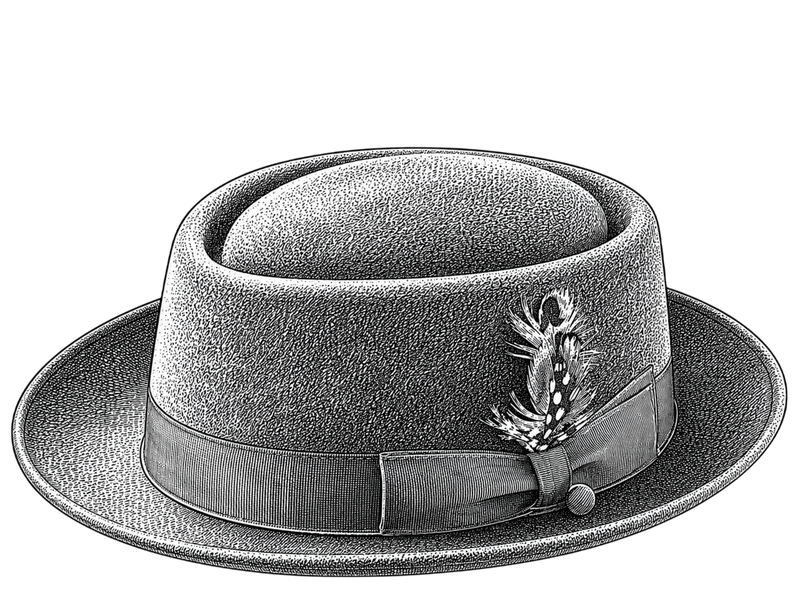
The homburg occupies an uncomfortable position in contemporary hat culture: it is more formal than a fedora, recognizable to most people through its association with gangster films and Winston Churchill, and rarely worn outside of specific ceremonial contexts. Understanding what it actually is and when it belongs is more useful than simply knowing it exists.
What Defines a Homburg Hat
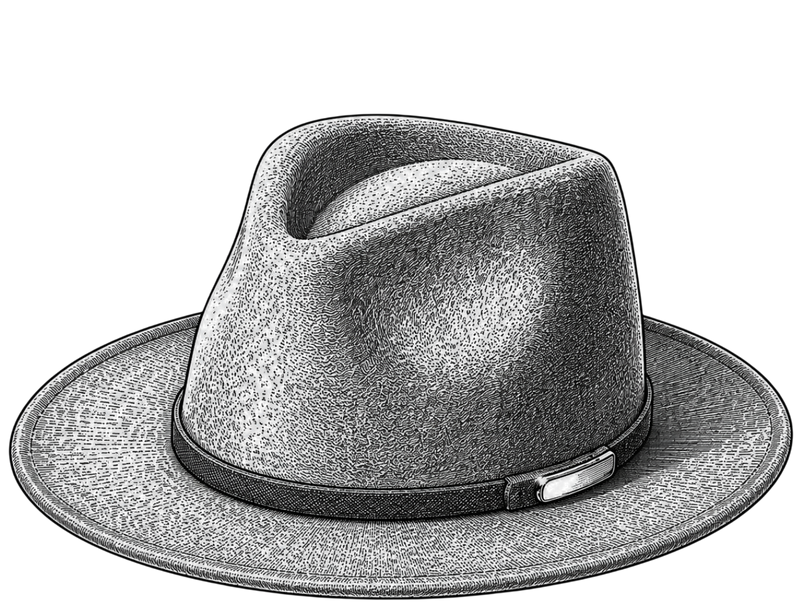
The homburg is a stiff felt hat with a single center crease in the crown and a brim that curls uniformly upward on all sides. Three features distinguish it from the fedora:
- Single center crease: The homburg crown has one crease running front to back at the center. Unlike the fedora, which has a pinched front (the teardrop or C-crown crease that pinches at the sides), the homburg has no side pinches. The crown above the crease forms a smooth, slightly rounded dome on either side of the center crease.
- Stiff construction: The homburg is more heavily shellacked than most fedoras, producing a stiffer, more formal hat that holds its shape rigidly. It does not have the felxibility that allows fedoras to be snapped or reshaped.
- Upturned brim all around: The brim curls upward consistently around the entire circumference. On a fedora, the brim can be snapped up in the back and down in front; on a homburg, the brim turns up uniformly on all sides.
The homburg also typically has a grosgrain ribbon on the edge of the brim (the brim binding) and a matching grosgrain ribbon around the crown base -- both more formal finishing elements than the simple ribbon found on many fedoras.
History: From Bad Homburg to Winston Churchill
The hat takes its name from the German spa town of Bad Homburg vor der Hohe, where it was developed or popularized in the late 19th century. Edward VII, while Prince of Wales, was introduced to the style at Bad Homburg in the 1880s and brought the hat back to England, where royal approval established it as fashionable.
By the early 20th century, the homburg was established as a formal city hat -- more dressed than the fedora, less formal than the top hat. It occupied the upper end of the fedora category in terms of formality, appropriate for business occasions, formal city wear, and semi-formal events where a top hat was not required.
Winston Churchill wore a homburg throughout his political career with such consistency that the hat became strongly associated with him. Photographs of Churchill in political and wartime contexts almost invariably show the homburg -- his hat becomes so consistently associated with him that a silhouette of the hat is sufficient to reference Churchill without the face.
In the United States, the homburg was adopted by political figures (Eisenhower wore one at his 1953 inauguration, breaking a long tradition of top hats at inaugurations) and by figures in mid-century cinema, where it became associated with formal authority and, through gangster films, with dangerous formal authority.
Who Wears a Homburg Today
Contemporary homburg wearing is primarily in three contexts:
Religious and ceremonial: The homburg is worn by certain Orthodox Jewish communities as part of formal or Shabbat dress -- the yiddish term for the homburg in this context is often simply hat. In these communities, the homburg has continuous unbroken tradition rather than revival status.
Formal occasions: At the most formal daytime events -- diplomatic receptions, state ceremonies, very formal weddings -- the homburg is occasionally worn as an alternative to the morning dress top hat. It reads as extremely formal and somewhat archaic in most contemporary contexts.
Deliberate heritage or vintage aesthetic: Men with a strong interest in 1930s-1950s formal menswear may wear a homburg as part of a deliberate period-influenced style. In this context it reads as an informed aesthetic choice rather than as conventional formal wear.
The Homburg vs. the Fedora
The practical question for most hat wearers is whether a homburg or a fedora better serves a given context. The answer depends on the specific need:
A classic fedora in quality felt with a well-set brim addresses nearly every contemporary hat occasion where a man might consider a homburg, at a formality level that is more contextually appropriate for most modern occasions. The homburg's greater stiffness and more formal finish signals a level of formality that is contextually correct at very few occasions and reads as slightly heavy for most occasions where a fedora reads as simply appropriate.
The homburg has a specific niche: occasions where maximum daytime formality is required and a top hat is not expected. Outside this niche, the fedora covers the same aesthetic territory with more practical versatility.
Find quality fedoras and classic felt hat styles in the Hatloom fedora collection.
Frequently Asked Questions
What is the difference between a homburg and a fedora?
Crown shape and stiffness are the primary differences. A homburg has a single front-to-back center crease without side pinches, a uniformly upturned brim, and a stiffer construction than a fedora. A fedora has a pinched crown (typically a teardrop or C-crown shape) with a brim that can be snapped in multiple positions, and a more flexible overall construction. The homburg is more formal and less versatile; the fedora is more casual and more adaptable.
When should I wear a homburg hat?
At very formal daytime occasions -- diplomatic events, the most formal weddings, state ceremonies -- where the formality level of morning dress or equivalent formal daytime wear is expected and where a top hat feels too much but a standard fedora too little. In most contemporary contexts, a quality fedora addresses the same occasions with more appropriate formality calibration. The homburg has specific relevance in Orthodox Jewish community formal dress, where it is the conventional formal hat.
What does a homburg hat look like?
A stiff felt hat with a medium-height crown featuring a single crease running front to back and a smooth dome on either side of the crease. The brim curls upward uniformly all around -- unlike a fedora whose brim can be angled differently at front and back. The overall impression is of a more rigid, more symmetrical, more formal version of the fedora. Classic colors are black, charcoal, and dark gray; mid-century photographs show brown and navy versions as well.
Did Winston Churchill wear a fedora or a homburg?
A homburg, consistently. Churchill's hat was the homburg -- the stiff, single-crease, uniformly upturned brim construction that distinguishes it from the fedora. The association is so strong that in some European countries and contexts, a homburg is colloquially called a Churchill hat.
Can a homburg be worn with a suit?
Yes, at the appropriate formality level. A homburg with a dark, formal suit -- a business suit in a quality fabric worn for formal occasions -- reads as appropriate at the upper end of business formal. With a standard business casual suit, the homburg's formality level is slightly higher than the suit warrants and the fedora is the more calibrated choice. The homburg works best with formal daytime suits and formal occasion wear; it is over-formal for most everyday suit wearing.