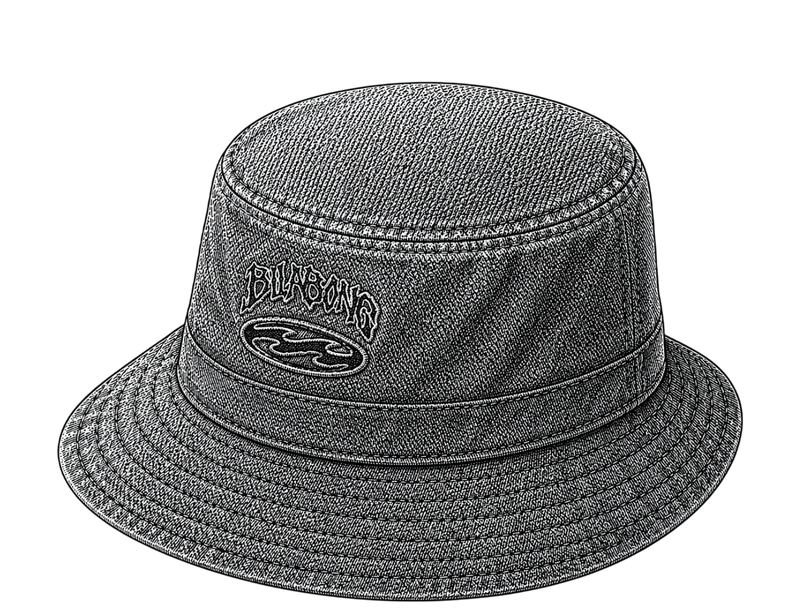
The bucket hat has been worn by Irish farmers, British soldiers, American fishermen, hip-hop pioneers, and Prada runway models. No other hat style has traveled such a complete cultural arc — from extreme utility to cultural symbol to high fashion and back again — across a single century. Understanding that arc explains why the bucket hat keeps returning: it solves a real problem so cleanly that every generation finds it independently useful, and then someone finds it aesthetically interesting.
The Origins: Utility Before Style
The bucket hat appears in its clearest early form in Ireland in the early 1900s — worn by farmers and fishermen as a rain hat. The downward-sloping brim shed water away from the face and neck; the soft construction allowed it to be pocketed or stuffed into a bag when not needed; the full-brim coverage protected against sun as well as rain. No brim required adjustment. No shape required maintenance. It was, in essence, the most functional hat a person could wear in unpredictable outdoor conditions.
The British Army formalized a version of this design as military headwear during the Boer War (1899–1902) and used variations of it through both World Wars. The US Army issued its own version — designated the M1951 utility hat — during the Korean War in the early 1950s. Military bucket hats were issued in olive drab and khaki, designed specifically for jungle and field patrol environments where sun protection and moisture management were operational requirements.
Vietnam and the American Military Era
The bucket hat became strongly associated with American military culture through the Vietnam War (1955–1975), where US soldiers wore the boonie hat — a wider-brimmed, ventilated variant of the standard bucket hat designed for tropical jungle conditions. The boonie hat had a wider brim than the standard military bucket hat, ventilation eyelets in the crown, and sometimes a band of loops around the crown for attaching foliage as camouflage. It became one of the most recognized pieces of Vietnam-era military equipment, worn in virtually every documentary and photographic record of the conflict.
Veterans returning from Vietnam brought the hat with them into civilian life. The military silhouette — rounded crown, full-circumference brim — entered American outdoor and workwear culture through this route, becoming common as a fishing hat, gardening hat, and general outdoor sun hat through the 1960s and 1970s.
Hip-Hop and the Urban Rebrand (1980s–1990s)
The transformation of the bucket hat from utility object to cultural symbol happened in New York in the early 1980s. The hip-hop community in the South Bronx adopted the bucket hat as part of the emerging visual vocabulary of the culture — alongside tracksuits, sneakers, and gold chains. LL Cool J was photographed wearing a Kangol bucket hat in 1985, an image that became one of the most reproduced in hip-hop's early visual history. The Kangol brand — British in origin, a workwear and sporting brand founded in 1938 — became synonymous with hip-hop style through this association.
Through the late 1980s and into the 1990s, the bucket hat became one of the defining silhouettes of hip-hop fashion. Artists including LL Cool J, Run-DMC, and later De La Soul and A Tribe Called Quest wore the hat as a core element of their stage and street presentation. De La Soul in particular used the bucket hat as an element of their Daisy Age aesthetic — a deliberately peaceful, positive counter-image to the harder edges of concurrent hip-hop styles.
British Acid House and rave culture adopted the bucket hat in the late 1980s through slightly different cultural channels, and Britpop bands of the mid-1990s — Oasis, Supergrass, The Charlatans — wore it as part of the casual-masculine working-class identity that defined the movement. The bucket hat became one of the most recognizable pieces of 1990s British pop culture, as strongly associated with the era as Liam Gallagher's parka.
Fashion's Reclamation (2000s–2020s)
Fashion houses began treating the bucket hat as a legitimate design object in the 2010s. Prada included bucket hats in multiple collections from 2013 onward, treating the utilitarian silhouette in luxury materials — nylon, leather, logo-print canvas. The move signaled that the bucket hat was no longer merely a subcultural reference but had achieved the status of a design classic — a silhouette so resolved and historically significant that it could be made in any material and for any price point without losing its identity.
The 2017–2020 streetwear boom — driven by social media, limited-edition drops, and the fusion of luxury and street aesthetics — brought the bucket hat to its broadest audience yet. Supreme, Stussy, Palace, and virtually every heritage streetwear brand issued bucket hats as central to their seasonal ranges. A Palace or Supreme bucket hat carried a cultural value that exceeded its material cost by orders of magnitude.
By 2020, the bucket hat had achieved a rare status: simultaneously a luxury fashion item (Prada, Gucci, Burberry), a streetwear essential, a heritage fishing hat, a beach accessory, and a festival staple — the same silhouette, across a price range from $8 to $800, worn in contexts with essentially nothing in common except the hat itself.
The Bucket Hat Today
The bucket hat now occupies a permanent position in global casual fashion rather than being a trend item. Its 2023 and 2024 presence in fashion collections, street photography, and everyday wear is not a revival — revivals imply the thing had gone away. The bucket hat has been in continuous production since the 1930s and in continuous widespread wear since the 1980s. What changes between the peaks is which cultural context is most visible: the streetwear context in 2018, the festival context in 2019, the work-from-anywhere context of 2021, the heritage menswear context in 2023.
The bucket hat endures because it works. It is one of very few fashion items with a continuous history of practical use — military, agricultural, recreational, urban — across a full century. That history is legible in the object itself, which is why every context that picks it up finds it coherent: the hat knows what it is and does not require explanation.
Find bucket hats in classic and contemporary colorways in the Hatloom bucket hat collection.
Frequently Asked Questions
Who invented the bucket hat?
No single inventor is documented. The functional design — circular-sewn fabric hat with downward-sloping brim — appears independently in Irish and British rural clothing in the early 1900s, and in military equipment development across multiple armies by the 1930s and 1940s. It is a design solution to a practical problem (weather protection, packability) that was arrived at by multiple manufacturers in similar ways across different contexts, rather than a product with a single origin.
What is the Kangol hat, and is it a bucket hat?
Kangol is a British brand founded in 1938 that produces multiple hat styles, but became associated with a specific flat-brimmed, structured cap (the Kangol 504) as well as a bucket hat style. The Kangol bucket hat is a bucket hat — the brand name and the category name are interchangeable in common usage. The brand's association with hip-hop from the 1980s onward means Kangol is sometimes used as a general term for any bucket hat in American vernacular, the same way Xerox is used as a general term for photocopying.
What is the difference between a bucket hat and a boonie hat?
The boonie hat is a wider-brimmed military variant of the bucket hat — typically 7–10 cm brim versus 4–6 cm on a standard bucket hat — with ventilation eyelets and sometimes a band of loops around the crown for camouflage. The boonie hat is designed for field and jungle conditions where maximum sun protection and ventilation are priorities. A standard bucket hat is a civilian design optimized for wearability and packability rather than tactical use. The terms are sometimes used interchangeably in casual use.
Why did De La Soul wear bucket hats?
De La Soul adopted the bucket hat as part of their Daisy Age aesthetic in 1989 — an intentional visual contrast to the harder, more aggressive imagery of concurrent hip-hop styles. The bucket hat, worn in casual colors with casual clothing, signaled positivity, approachability, and a connection to everyday life rather than street toughness. It was a deliberate semiotic choice — the hat meant something specific in context, not merely a fashion preference.
Is the bucket hat a timeless piece or a trend?
Both, simultaneously. The bucket hat is timeless as a design object — the silhouette has not required updating in 100 years because it is functionally optimal for what it does. It cycles through trend peaks as different cultural moments pick it up and make it visible, but it does not disappear between peaks. What changes is its cultural salience, not its existence. A bucket hat purchased now will still be a functioning, contextually coherent hat in 20 years — the same cannot be said for most trend-driven accessories.