No hat in history has moved from specialized workwear to universal default faster than the baseball cap. It took roughly 40 years to go from a sport-specific head covering to the most worn hat style on earth. The reasons why reveal something about how clothing actually spreads through culture.
The Origin: A Functional Problem on a Baseball Diamond
Baseball in its earliest organized form — the 1840s and 1850s in the northeastern United States — was played in direct sunlight for hours. Players needed eye protection. The options available at the time were the wide-brim straw hat, the military kepi, and various agricultural work hats. None were ideal for athletic movement.
The Brooklyn Excelsiors are credited with the first recognizable baseball cap in 1860: a rounded crown with a short forward-facing brim. The design did not emerge from a hat maker. It emerged from a team solving a practical problem — shading the eyes while allowing full head mobility for throwing, catching, and batting.
By 1900, some version of the forward-brim cap was standard across professional baseball leagues. The form was established. What changed over the next century was material, construction, and cultural context.
The Structured Era: 1900–1950
Early professional baseball caps were made from wool flannel — the same material as the uniform. They had six-panel construction, a button on top, and a stiff, pre-curved brim. The crown was fully structured with a buckram lining that held the dome shape without needing to be worn.
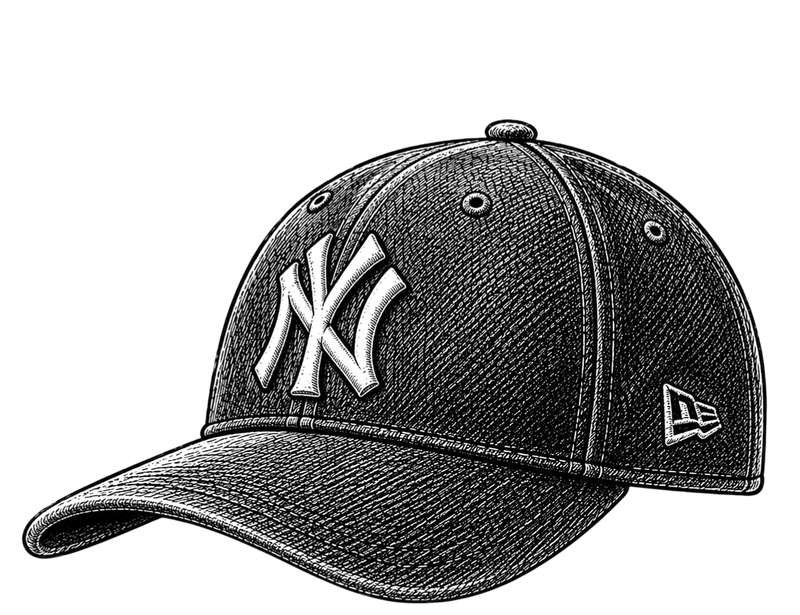
Teams began using caps as identity markers in this period. The New York Yankees introduced their iconic NY logo on the cap in 1909. The cap became the most visible element of team identity — more recognizable than the jersey number, more consistent across different uniform variations.
Key metric: By 1920, every Major League Baseball team had a standardized cap design that was reproduced consistently season to season. The cap had become a brand asset before the concept of brand management existed.
New Era and the Fitted Cap: 1920–1954
Ehrhardt Koch founded the New Era Cap Company in Buffalo, New York, in 1920. For the first three decades, New Era was one of many cap manufacturers supplying teams. The turning point came in 1954 when New Era signed an exclusive contract with the Cleveland Indians — the first such contract in baseball.
The fitted cap — no adjustable strap, sized precisely to head circumference — became the professional standard. This mattered because fit quality became visible. A cap that sat correctly on the head looked different from one that was too large or small. Players and eventually fans began treating the cap as a precision object.
The Snapback: Democratizing the Cap
The adjustable snapback closure — a plastic snap at the rear that allowed one cap to fit a range of head sizes — expanded the cap market beyond fitted sizing. First appearing in the 1950s and becoming dominant by the 1970s, the snapback made caps commercially viable for mass retail without the complexity of stocking multiple sizes per style.
The trade-off was fit precision. A snapback cap worn at its correct size fits approximately — not exactly. This distinction between the precisely fitted cap and the adjusted snapback became a style signal in hip-hop culture in the 1980s and 1990s, where fitted caps (worn correctly or deliberately oversized) carried different cultural weight than snapbacks.
Hip-Hop and the Cap as Cultural Statement: 1980s–2000s
The baseball cap's transformation from sporting accessory to cultural statement accelerated through hip-hop in the 1980s. Artists wore caps as part of a deliberate visual language — team logos, specific cities, brim angles, and positioning on the head all carried meaning within the culture.
Three specific practices changed how caps were worn broadly:
- Flat brim: Keeping the brim uncurved — often with the sticker left on — signaled a specific authenticity within hip-hop culture. This spread into mainstream fashion through the 1990s and 2000s.
- Backward wear: Turning the cap backward, a practical move by catchers in baseball to allow mask placement, became a broader casual and youth statement adopted well outside its original context.
- Tilted positioning: Wearing the cap tilted to one side as a visual asymmetry — adopted from specific street and gang cultural contexts and subsequently diffused into mainstream youth fashion.
The mechanism of spread: Music television (MTV launched 1981) allowed regional style signals to transmit nationally within months rather than years. A cap worn a specific way in New York was visible nationally by the following weekend. No prior fashion medium had this speed of transmission.
Nike, Jordan, and the Logo Cap: 1990s
The collaboration between Nike and Michael Jordan — and specifically the Air Jordan brand starting in 1985 — introduced a new category: the logo cap as luxury object. Caps carrying specific brand or team affiliations at premium price points were purchased not for use but for collection and display.
By the late 1990s, the fitted New Era cap retailing at $30–$35 was treated as a collectible by a significant portion of its buyers. Limited colorways, team-specific releases, and collaboration editions created scarcity that elevated the object above its functional category.
The Trucker Cap Interlude: 2000–2010
The trucker cap — a mesh-backed, foam-fronted cap originally manufactured as promotional merchandise for agricultural and trucking companies — had a significant fashion moment in the early 2000s. The style was adopted ironically by celebrities and fashion-forward consumers, then rapidly entered mainstream production.
The trucker cap moment is notable as an early example of working-class functional clothing being adopted as fashion signifier by an entirely different demographic — a pattern that would repeat with Carhartt, Dickies, and other workwear brands through the 2010s.
The Baseball Cap in 2025
The baseball cap is, by volume, the most manufactured hat style in the world. The global cap market is estimated at over $20 billion annually. Every major fashion house — from Supreme to Balenciaga to Prada — produces caps. The style has no single cultural ownership and no single demographic.
What remains consistent across all iterations is the core design: six-panel construction, forward brim, structured or unstructured crown. The form has not substantively changed since 1900. Its universality is the result of that functional clarity — it is a resolved design that solves the problem it was created to solve.
Explore structured and unstructured cap styles in the Hatloom collection.
Key Facts at a Glance
- First recognizable design: Brooklyn Excelsiors, approximately 1860
- Standard material (early era): Wool flannel — same as the team uniform
- New Era founding: 1920, Buffalo, New York
- First exclusive MLB contract: New Era with Cleveland Indians, 1954
- NY Yankees logo on cap: First used 1909 — one of the longest-running logo designs in sport
- Global market size: Estimated $20+ billion annually as of 2024
- Construction: Six-panel design standard since the early 1900s — unchanged in fundamental structure
Frequently Asked Questions
When was the baseball cap invented?
The first recognizable baseball cap — a rounded crown with a forward-facing brim — appeared around 1860, attributed to the Brooklyn Excelsiors. By 1900, some version of the forward-brim cap was standard across professional baseball leagues. The modern six-panel structured cap became standard through the early 20th century.
Why do baseball caps have a button on top?
The button at the crown apex is a construction artifact — it covers the point where the six fabric panels meet and are sewn together. It serves no functional purpose in the wearing of the hat. Its persistence across nearly all cap styles is a case of a construction solution becoming a design convention.
What is the difference between a fitted cap and a snapback?
A fitted cap is sized precisely to head circumference — no adjustment mechanism, one size per head measurement. A snapback has a plastic snap closure at the rear allowing adjustment across a range of sizes. Fitted caps offer more precise fit and a cleaner silhouette. Snapbacks are more accessible for gifting and retail without sizing complexity.
Why do people leave the sticker on baseball caps?
The practice originated in hip-hop culture in the 1980s and 1990s as a signal of authenticity — a new, untouched cap. It later became a style convention in its own right, independent of its original meaning. The sticker-on approach is now a recognized aesthetic choice rather than a statement about newness.
What is a dad cap?
A dad cap is an unstructured, low-profile baseball cap with a curved brim and an adjustable strap closure (usually fabric or brass buckle rather than plastic snap). The name references the practical, unstudied way the style tends to be worn — without deliberate brim curving or precise positioning. The style became a fashion item in the 2010s precisely because of its deliberately casual appearance.