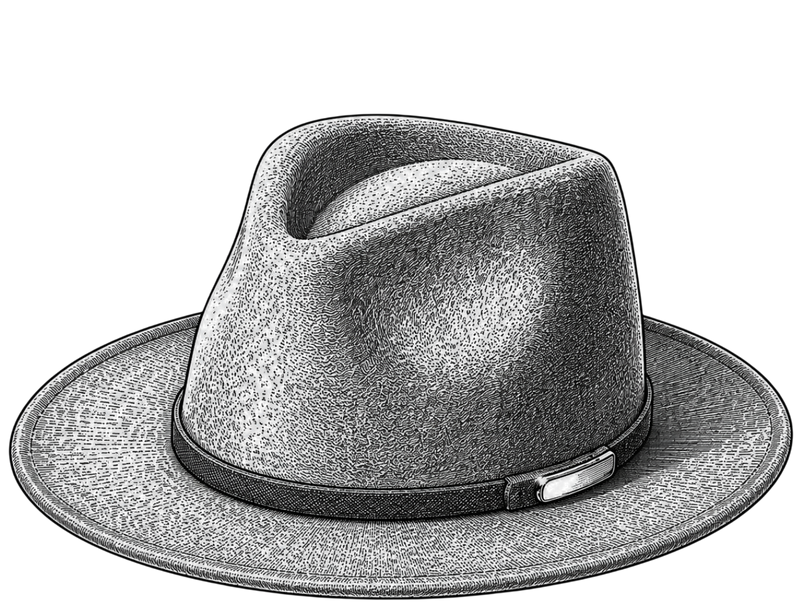
Most fedora "buying guides" are written by people who have never blocked a hat. Here is what actually separates a fedora that lasts a decade from one that collapses after a rainy commute.
The Three Numbers That Matter Before You Buy
- Felt weight: Anything under 80g per hat body feels light in hand but loses shape within a season. 100–140g is the range where structure and wearability balance out.
- Fiber blend: 100% wool felt holds a crease better than wool-rabbit blends, but pure rabbit fur felt outperforms both for water resistance and long-term shape memory.
- Brim curl retention: A quality brim returns to its set curl after being pushed flat by hand. If it stays flat, the felt was under-stiffened at the factory.
Insight: A fedora's price rarely tracks its actual material grade in the $40–$120 range — many brands charge a premium for branding, not felt quality. The gap becomes real above $150, where labor (hand-blocking, hand-finished brim edges) starts driving cost.
Fit Comes Before Style
A fedora that is technically "your size" but rests on your ears rather than your skull was sized for an average that does not include you. Measure your head circumference 1cm above the ear line — not at the brow — for the most accurate result.
Comparison Snapshot
| Factor | Budget Fedora (<$60) | Mid-Tier ($60–$150) | Investment-Grade ($150+) |
|---|---|---|---|
| Felt source | Wool blend | Wool, higher density | Fur felt or premium wool |
| Construction | Machine-stitched only | Machine + reinforced brim | Hand-finished edges |
| Expected lifespan | 1–2 seasons | 3–5 years | 10+ years with care |
The Real ROI Question
A $180 fedora worn 60 times a year for 8 years costs roughly $0.38 per wear. A $40 fedora replaced every 18 months over the same period costs more in total and never develops the shape-memory that makes a hat feel personal.
Bottom line: Buy on felt weight and construction transparency, not on brand recognition alone. Ask any retailer for the gram weight of the felt — if they don't know, they didn't make the hat themselves.
Frequently Asked Questions
What felt weight should I look for in a premium fedora?
100–140g for the hat body is the optimal range. Below 80g, the felt lacks the density to hold a crease through a full season. Above 140g, the hat becomes noticeably heavy for daily wear without a proportional gain in durability.
How often should a quality wool fedora be re-blocked?
Every 1–2 years with regular wear, or when the crown visibly loses its set crease. Steam and a wooden block restore shape at home; a hatmaker can perform a full re-block if the shape has distorted significantly.
Is a fedora above $200 actually worth the price?
At that price point, labor becomes the primary cost driver — hand-blocking, hand-finished brim edges, and quality sweatband construction. Worn 60 times a year for 8 years, a $200 fedora costs roughly $0.42 per wear and develops a personalized fit no cheaper hat can replicate.
Related Reading
- Wide-Brim vs. Short-Brim Fedora: Which Suits Your Face Shape?
- Wool Felt vs. Fur Felt Hats: Which Is the Better Investment?
- How to Tell If a Hat Is Actually High Quality Before You Buy Online
Shop Hatloom
Every hat in our collection is selected against the material and construction standards described above — felt weight, fiber grade, and brim integrity verified before listing.