The Australian slouch hat is one of the most functionally specific hat designs in military history -- every element of its appearance was created to solve a particular physical or tactical problem, and the hat that emerged from these solutions became one of the strongest national identity symbols in the Southern Hemisphere. Its physical form and its meaning are inseparable from the conditions that created them.
What the Slouch Hat Is
The Australian slouch hat is a broad-brimmed felt hat with a distinctive feature: one side of the brim is permanently turned up and secured against the crown. This turned-up side (the left side in Australian military convention) creates the asymmetric profile that gives the hat its immediately recognisable silhouette.
The hat is made from fur felt (traditionally rabbit fur felt in Australian production) in a khaki or light brown colour. The interior has a leather sweatband; the exterior shows a puggaree -- a ribbon or band of fabric traditionally wrapped around the crown and associated specifically with this hat type. For ceremonial use, a plume or badge is attached at the point where the brim turns up against the crown.
Origins: Queensland Mounted Infantry and the 1880s
The slouch hat's origin in Australian military use is traced to the Queensland Mounted Infantry in the 1880s. The specific design problem: a standard brimmed military hat on horseback created a conflict between the broad brim needed for sun protection and the vertical obstacles (low branches, undergrowth) encountered in Australian bush conditions. A brim that extended equally on both sides caught on vegetation when riding through bush at speed.
The solution -- turning up one side of the brim permanently -- reduced the lateral projection on the left side (the side more exposed when riding, where a mounted soldier's rifle was typically carried), allowing freer movement through dense vegetation. The right side of the brim remained full-width for sun protection. The single upturned side was practical, not decorative.
The Boer War and Global Attention
Australian forces in the South African Boer War (1899-1902) wore their distinctive slouch hats and attracted significant attention from British and international observers -- the hat looked unlike any other military headwear in the conflict. The performance of Australian troops in the Boer War, combined with the visual distinctiveness of the hat, began the association between the slouch hat and Australian military character: practical, adaptive, and unapologetically distinctive from British convention.
World War I consolidated this association. The ANZAC forces at Gallipoli and in France were identifiable at a distance by their slouch hats -- no other Allied force wore anything similar. The hat became associated with the ANZAC qualities that were celebrated in Australian national memory: resourcefulness, physical endurance, and a non-deferential relationship with British military hierarchy.

ANZAC Day and the Hat's Ceremonial Role
ANZAC Day (April 25, commemorating the 1915 Gallipoli landing) is the most important occasion in the Australian military commemoration calendar, and the slouch hat is the central visible element of ANZAC Day dress for veterans and participants. The hat's presence at dawn services, marches, and memorial events is so consistent that it functions as a visual marker of the occasion itself -- the sight of a slouch hat immediately communicates ANZAC connection to Australian observers regardless of any text or context.
The Hat in Contemporary Non-Military Use
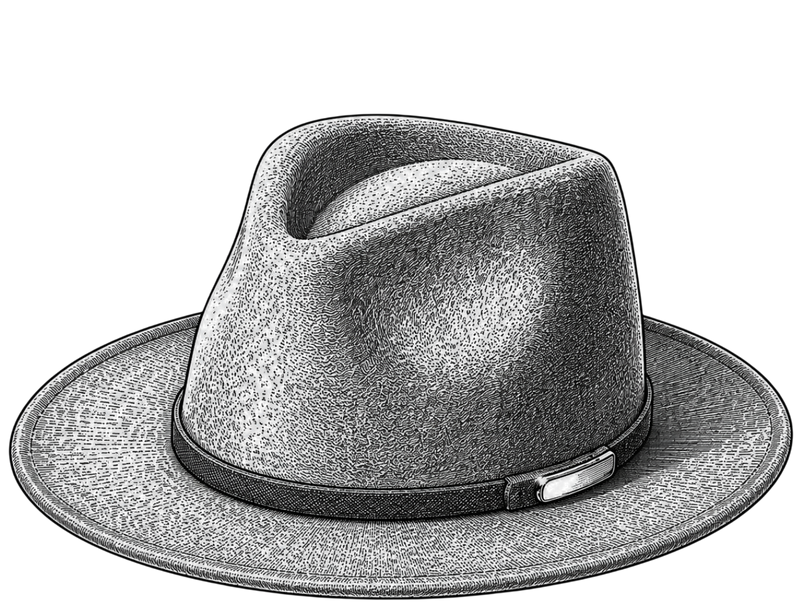
Outside military and ceremonial contexts, the slouch hat exists in the broader category of Australian wide-brim felt hats. The commercial versions -- which retain the turned-up brim but may not have the specific puggaree or military badge details -- are worn as casual and outdoor wear, particularly in rural Australia where the hat's sun protection, durability, and low-maintenance properties are practical advantages.
The Australian wide-brim felt hat has been adopted in international fashion contexts as a distinctive silhouette -- the asymmetric single-turned brim creates a visual identity unlike any European hat tradition.
Browse wide-brim felt hats at Hatloom.
Frequently Asked Questions
Why is the left side of the brim turned up?
The left side turn-up in Australian military convention corresponds to the rifle shoulder -- Australian soldiers typically carried their rifles on the left side, and the turned-up left brim allowed freer movement of the rifle without the brim catching on the barrel or action. The practical origin of the left turn-up is firearms handling rather than aesthetic choice. Once established as convention in the Australian military, the left side turn-up became the standard regardless of whether individual soldiers were rifle-armed or not.
Is the slouch hat the same as a bush hat?
No. A bush hat is a generic term for any wide-brimmed, practical outdoor hat suited to bush or wilderness conditions -- it describes a function rather than a specific design. The slouch hat is a specific design with the distinctive single-turned brim. A slouch hat is a type of bush hat in functional terms, but a bush hat is not necessarily a slouch hat. The term bush hat also refers to the wide-brimmed military hats worn by various other nations' forces, including the South African and British armies, which have different designs from the Australian slouch hat.
What is the puggaree on a slouch hat?
A puggaree (also spelled puggree or pagri) is a band of fabric -- typically cotton muslin or a folded ribbon -- wrapped around the crown of the hat. It originates in Indian and South Asian hat tradition (the word is from Hindi/Urdu) and was adopted into British colonial military headwear as a practical sweat-absorbing band that also held the turned-up brim in place. The puggaree on an Australian slouch hat typically shows regimental or unit colours and is the position where unit identification is displayed on the hat.
Can civilians wear the Australian slouch hat?
Yes. The slouch hat in its civilian commercial form (without specific regimental insignia, without a military puggaree in specific regimental colours) is worn as outdoor and casual headwear without restriction. It is sold commercially in Australia as a practical hat and as a heritage item. In ceremonial ANZAC Day contexts, the wearing conventions are more specific -- the hat with specific unit insignia is associated with earned military affiliation, and wearing such insignia without entitlement is considered inappropriate and is legally restricted in some Australian states. Commercial versions without insignia are unrestricted.