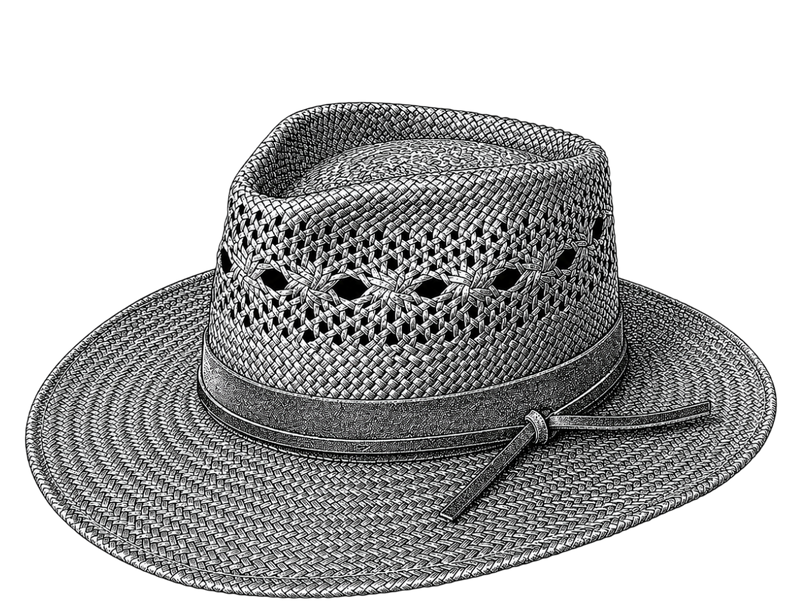
Hat storage is where most hat damage happens. The hat survives being worn correctly for years and is destroyed in a drawer in a single off-season. Understanding why storage damages hats -- and what correct storage actually requires -- protects a hat investment that may represent decades of potential wear.
How Hats Are Damaged in Storage
Five mechanisms damage hats during storage:
- Compression: a hat stored under or inside other items has weight pressing down on the crown or brim. Felt hats deform under sustained pressure; straw hats crack at the pressure points. The damage may not be visible immediately but becomes apparent after storage ends.
- Brim-down storage: a hat placed resting on its brim (as people often store hats on a surface) has the brim bearing the weight of the crown continuously. Over time, the brim flattens, rolls, or warps at the contact points. This is one of the most common storage errors.
- Direct sunlight: UV exposure bleaches hat materials. A felt hat in direct sunlight fades unevenly; a straw hat in direct sunlight loses colour and becomes brittle faster than one stored in shade. Even brief daily exposure to sunlight through a window accumulates over months of storage.
- Humidity extremes: high humidity promotes mould growth on natural fibre hats; very low humidity (heated indoor spaces in winter) dries natural straw and makes it brittle and more prone to cracking. The ideal storage humidity for most natural fibre hats is moderate -- similar to comfortable room conditions.
- Temperature extremes: very high heat (an attic in summer, a car in summer) can cause felt to distort and straw to dry out. Very cold temperatures are less damaging but can make straw brittle when it is then handled.

Correct Storage for Felt Hats
The ideal storage for a felt hat:
- Hat box: a round hat box slightly larger than the hat in diameter, with the hat stored crown-down (resting on the crown brim-up inside the box). The crown's domed surface distributes weight evenly; the brim is free of contact with any surface. Tissue paper inside the crown provides additional support and prevents the crown from collapsing inward under its own weight over time.
- Hat stand: a wooden or metal hat stand (a form that approximates the head shape) supports the hat from inside the crown without any surface pressure on the brim. This is the preferred display storage for regularly worn hats -- it is both functional and presentable.
- Location: away from direct light, at room temperature, in a space with moderate humidity. A closet shelf (not the floor) is typically appropriate.
What not to do:
- Do not stack hats on top of each other (the weight of upper hats deforms lower ones)
- Do not store in plastic bags (traps humidity, creates mould conditions)
- Do not store brim-down on any surface
Correct Storage for Straw Hats
Straw requires more humidity management than felt:
- Store in a cool, moderately humid space -- neither an arid heated room nor a damp basement
- A hat box with a small piece of slightly damp paper (not wet -- just not completely dry) in a sealed box maintains a slightly higher humidity environment suitable for straw
- Packable straw hats can be stored rolled in their tubes; non-packable structured straw hats should be stored like felt hats -- crown supported on a stand or in a box brim-up
- Before long-term storage (end of season), wipe the exterior with a clean damp cloth to remove salt and dust accumulation. Salt residue from sweat or sea spray can damage straw fibres during storage.
Correct Storage for Baseball Caps and Soft Hats
Structured baseball caps are more storage-tolerant than felt or straw hats but have specific requirements:
- A structured cap should be stored with the crown shape supported -- a cap stand, a bowl of approximately the correct size, or the original packaging if it has a form
- Do not fold the bill of a structured cap (the bill will not unfold correctly and may retain a crease)
- Stacking caps directly on top of each other compresses the lowest cap's crown; use a cap rack or hang each cap individually if storing multiple caps
Seasonal Hat Rotation
At the end of each hat season:
- Clean the hat according to its material (brush felt, wipe straw, hand wash caps if needed)
- Allow to dry completely before storing -- a damp hat in storage grows mould
- Inspect for any damage that should be addressed before storage (loose sweatband stitching, bent brim sections, loose hatband) -- storing damaged hats means the damage may worsen or set permanently during the off-season
- Store in appropriate conditions as described above
- At the start of the next season, air the hat before wearing -- this refreshes any compressed fibres and removes any storage odour
Browse hat storage accessories including hat boxes and hat stands at Hatloom.


Frequently Asked Questions
Can I store a felt hat in a vacuum bag?
No. A vacuum bag compresses everything inside it, which is precisely the mechanism that damages hats. A felt hat stored in a vacuum bag will have its crown and brim compressed by the vacuum pressure and may not return to its original shape when released, particularly if stored for an extended period. Vacuum bags are appropriate for compressible items like clothing; they are not appropriate for any hat with structural shape that must be maintained.
How do I fix a hat that was stored brim-down and now has a warped brim?
Steam from a kettle or steam iron held at 20-30 cm makes felt temporarily pliable. Apply steam evenly to the warped brim area until the felt softens, then gently reshape the brim to the correct angle and hold it in position (on a flat surface, or with the brim pressed between your hands) until it cools and sets. Allow to dry completely before wearing or storing. For straw, the same approach using light dampening works, but straw is less responsive to reshaping than felt and may retain some warp if the storage damage was significant.
How long can a hat be stored without damage?
Indefinitely, if stored correctly. Quality felt hats from the 1930s-1960s regularly appear in wearable condition in vintage markets after 50-80 years of storage, because they were stored in hat boxes in appropriate conditions. The storage duration is not the risk factor; the storage conditions are. A hat stored incorrectly for three months may sustain more damage than a hat stored correctly for thirty years.
What is the best hat storage solution for a small space?
Wall-mounted hat hooks or a narrow hat rack are the most space-efficient storage for multiple hats. A hat hook should have a curved, hat-safe contact surface (a wooden or padded hook rather than a metal spike) that supports the crown from inside without deforming it. For a single prized hat in a small space, a hat stand on a shelf is appropriate. The key requirement regardless of space: the brim must not be bearing the hat's weight, and nothing should be resting on the crown.