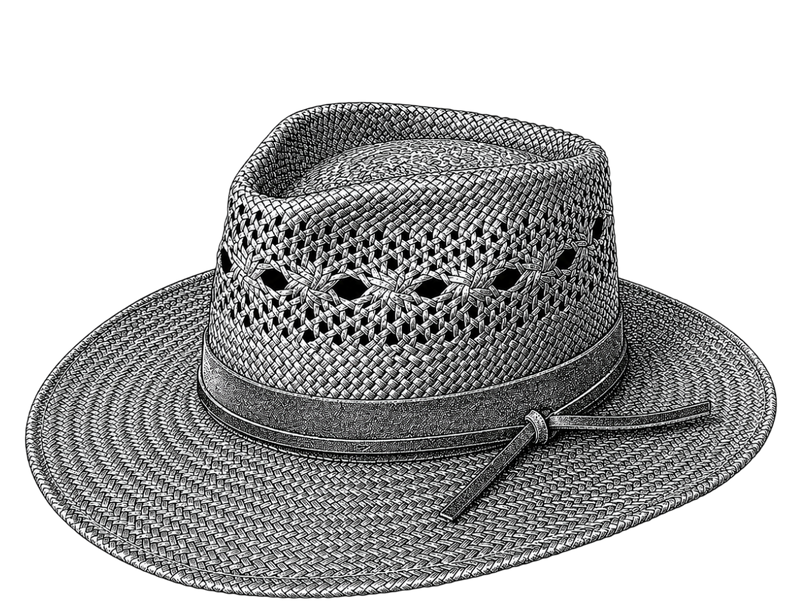
Every structured hat starts as an unshapen cone or dome of material. The process of transforming that cone into a fedora or flat cap is called blocking -- and blocking is the skill that separates a hat that holds its shape from one that does not. Most hat buyers have never seen it and have no mental model for what makes a blocked hat different from an unblocked one. This changes the kinds of quality questions you are able to ask when buying a hat.
What Blocking Is
Hat blocking is the process of shaping a hat over a wooden or metal mold (the block) using steam, pressure, and time. The block defines the crown shape; the brim is shaped separately using a brim press or by hand. Once shaped and dried in position, the hat material -- felt, straw, or fabric -- holds the form created by the block.
The term block refers to both the process (to block a hat) and the tool (a hat block). Hat blocks are precision woodturning tools -- historically made from hardwood turned on a lathe to exact head-size specifications, increasingly made from aluminium for professional production. A quality hat maker maintains a library of blocks in different sizes and crown profiles.

The Felt Hat Blocking Process
Step 1: The Cone or Capeline
A felt hat begins as a felt cone (for dome-crown hats) or a capeline (a flat disc with a central dome, used for hats where the brim and crown are shaped from one piece). The cone or capeline is made from loose wool or fur fibre that has been wetted, compacted, and dried into a flat felt sheet, then formed into the cone or capeline shape.
Step 2: Stretching and Sizing
The cone is stretched over a sizing ring to the correct head circumference. This step sets the internal dimension of the hat. The relationship between cone size and head size is not one-to-one -- the blocking process stretches and compacts the felt, and hat makers work with specific material allowances for each block and felt weight.
Step 3: Steam Application
Steam is applied to the felt to make it temporarily pliable. Felt is a thermoplastic material -- its fibre structure allows it to be reformed when heated with moisture and then set in the new position when it cools. Professional hat production uses industrial steamers; artisan hat makers use a steam kettle or steam iron. The felt must be steamed evenly to avoid creating stress points where the material was shaped more or less than adjacent areas.
Step 4: Blocking
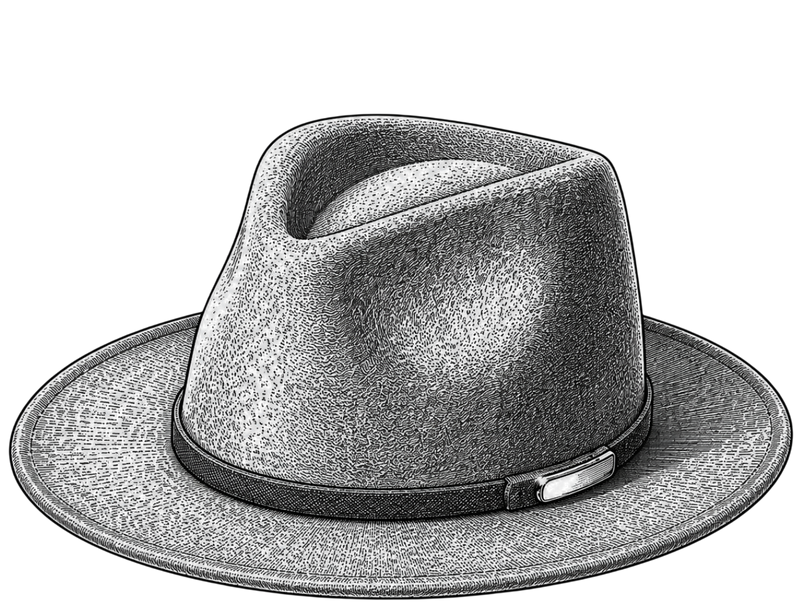
The steamed cone is pulled down over the hat block firmly and evenly. For a fedora, the block defines the crown height, crown width, and any specific profile the hat maker wants (some blocks have slight inward curve at the sides; others are purely cylindrical). The hat is worked down onto the block by hand or with a wooden tool, ensuring the felt conforms evenly to the block's surface without wrinkles or thinning.
Step 5: Brim Setting
The brim is spread flat (or shaped to the intended profile) and pressed. Brim shape is created by a brim press (flat plates that press the brim to a consistent angle) or by hand over a brim mold. The brim edge is typically bound with a grosgrain ribbon or left raw and ironed flat.
Step 6: Drying and Setting
The blocked hat is allowed to dry completely in position before being removed from the block. Removing the hat before it is fully dry risks deformation -- the felt can shift from its shaped position while still warm and moist. Full drying time depends on felt weight and ambient humidity but is typically several hours.
Step 7: Finishing
After blocking: the crown shape may be finalised by hand (the pinching or creasing that creates the fedora indentations); the hatband is attached; the sweatband is sewn in; the brim edge is finished. These finishing steps are where artisan skill is most visible -- the quality of the pinch, the cleanness of the hatband attachment, and the precision of the sweatband installation are all visible in the finished hat.
Straw Hat Blocking
Straw hats are blocked using similar principles but different materials. Woven straw (toquilla, seagrass, paper straw) is dampened rather than steamed -- wetting the straw softens it sufficiently to conform to a block. The hat is worked onto the block wet, the brim pressed or shaped, and the hat allowed to dry in position. Because straw is less thermoplastic than felt, it is more prone to cracking if over-bent or reshaped repeatedly after the initial blocking.
What Blocking Quality Affects
The quality of the blocking process determines several aspects of the finished hat that are visible to a knowledgeable buyer:
- Crown symmetry: a well-blocked hat has a crown that is symmetrical when viewed from the front. An asymmetric crown -- one side of the crown different from the other -- indicates inconsistent blocking pressure or a damaged block.
- Brim flatness: a well-blocked brim is consistently flat (or consistently curved, for shaped brims) across its full width. Unevenness in brim plane is a blocking quality indicator.
- Hat shape memory: a well-blocked hat returns to its intended shape after minor compression. Felt that was insufficiently steamed during blocking will lose shape faster than correctly processed felt.
Browse hats made with precision blocking and quality materials at Hatloom.

Frequently Asked Questions
Can a hat be re-blocked at home?
Felt hats can be partially re-blocked at home using steam from a kettle. Hold the misshapen area above the steam source at approximately 20-30 cm, allow the steam to penetrate the felt for 10-20 seconds until it becomes pliable, then reshape by hand and allow to cool in the new position. This works for minor deformations -- a pushed-in crown, a slightly bent brim. For significant reshaping, a hat maker with a blocking stand and the correct size block will produce a more precise result. Straw hats can be partially reshaped with light dampening but are more crack-prone and benefit from professional handling for anything beyond very minor corrections.
How long does professional hat blocking take?
A hand-blocked hat at an artisan hat maker takes approximately 30-60 minutes of active work for the blocking and shaping process, plus several hours of drying time. Production blocking in a commercial hat factory is faster through mechanised equipment but still involves sequential steps with drying time between them. A complete felt fedora from unblocked cone to finished hat represents a minimum of several hours of production time, which is one reason quality felt hats cost meaningfully more than mass-produced alternatives where blocking processes are compressed or simplified.
Why does a quality hat hold its shape better?
Several quality variables contribute to shape retention: the felt material itself (fur felt has better thermoplastic properties than wool felt, meaning it sets more permanently during blocking); the completeness of the steaming process (under-steamed felt is less fully reformed and reverts toward its pre-blocked state faster); the drying conditions (a hat removed from the block before fully dry will not hold its blocked shape as well as one that dried completely on the block); and the finishing (a well-constructed sweatband stiffens the head opening and maintains the hat's circumference dimension). A cheap hat compromises one or more of these variables; a quality hat optimises all of them.
What is the difference between a hand-blocked and factory-blocked hat?
Hand-blocked hats are shaped individually by a craftsperson who applies steam, works the felt onto the block by hand, and uses skill and judgment at each step to achieve the intended shape. Factory-blocked hats use hydraulic or mechanical presses that apply consistent pressure but cannot respond to individual material variations. Both produce blocked hats, but hand-blocking allows for material-specific adjustments (extra steam on a denser area of felt, specific attention to the brim edge) that mechanical blocking cannot provide. Hand-blocked hats typically show slightly more individual character and can be shaped to more precise specifications; factory-blocked hats are more consistent within a production batch but may have minor variation between batches.