The ribbon around a hat's crown is the most frequently overlooked design element in hat wear -- and also the most frequently changed, replaced, and personalised element in hat history. The hatband is where individual expression was permitted when the hat itself was standardised by social convention. Understanding what hatband styles mean and where they came from turns an invisible detail into a legible one.
What the Hatband Does Functionally
Before style, the hatband has structure. The ribbon or band around the base of a hat's crown serves several practical functions:
- Structural reinforcement: the band stabilises the junction between crown and brim, which is the highest-stress point in felt hat construction. Without the band, the crown base weakens faster under repeated flexion.
- Sweat protection: on the exterior, the hatband acts as a secondary barrier to sweat migration through the felt from the interior sweatband. On work and outdoor hats, the exterior band absorbed and concealed significant weathering.
- Size adjustment: historically, the band was loosened or tightened to adjust fit -- particularly relevant before standardised sizing made hat sizing precise.
- Attachment point: feathers, cockades, badges, and decorative elements were attached to the hatband rather than the hat material itself, allowing them to be removed and replaced without damaging the hat.
The History of Hatband Styles
18th Century: Cockades and Status Symbols
The 18th-century hatband's most culturally significant form was the cockade -- a pleated or folded fabric or ribbon rosette worn at the hatband position on the left side of a tricorn or bicorn hat. Cockades were used throughout European military and political culture as identity markers: French revolutionary cockades were tricolour; British military cockades were black silk; American colonial militia cockades were often black with a white centre. The cockade positioned the hatband as a political and hierarchical communication device rather than simply a decorative one.
Victorian and Edwardian Era: Club and Regimental Stripes
The club stripe hatband on a boater or straw hat was one of the defining men's fashion elements of the 1880s-1910s period. The stripe pattern indicated membership: rowing club colours, school colours, cricket club affiliations, and later regimental colours. The stripe pattern (diagonal stripes in two or three colours) communicated social membership in a coded way that was immediately readable to those within the relevant group and opaque to those outside it.
This tradition is the origin of the striped grosgrain hatband that remains a standard option on quality fedoras and straw hats today -- most wearers now choose stripe patterns for aesthetic reasons rather than club membership signals, but the form comes directly from the Victorian institutional identity marker.
1920s-1940s: The Grosgrain Ribbon Dominates
The simple grosgrain ribbon hatband became the dominant form through the 1920s and into the mid-century. Grosgrain -- a ribbed, textured ribbon -- was durable, took colour well, and held its shape around the crown without wrinkling or deforming. It also reinforced the crown base as a structural element while remaining visually clean and compatible with the more streamlined hat silhouettes of the modernist 1920s and 1930s.
The bow or overlap position (how the ribbon ends are joined) standardised to the left side of the hat in this era -- the position where the ribbon ends are folded or tied. This became the default position that persists in most Western hat traditions.
1950s-1960s: Feathers and Decoration
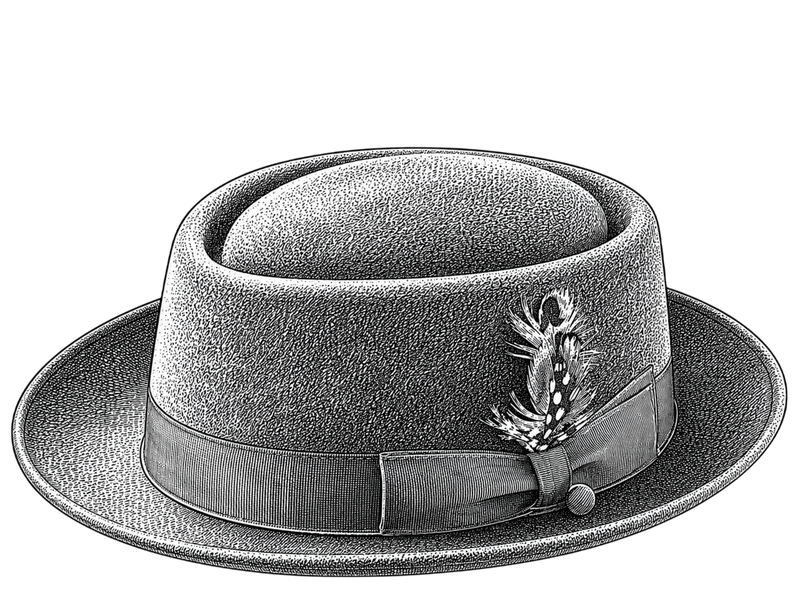
The mid-century saw a revival of the feather-in-the-hatband tradition -- particularly in men's fedoras, Tyrolean hats, and Alpine-influenced styles. The small feather or cluster of feathers attached to the hatband at the left side became a common mid-century hat finishing detail. The Tyrolean hat made this its defining feature, but the feather decoration migrated into mainstream American and European fedora culture through the 1950s.
The feather tradition follows a very old practice -- the oldest documented use of feathers in hatbands is medieval, where they served as rank markers in military contexts. The 1950s adoption was aesthetic rather than functional, but the form is an ancient one.
1970s-Present: Simplification and Material Diversity
From the 1970s onward, hatband complexity reduced as hat wearing itself became less formalised. The contemporary hatband is most often a simple grosgrain ribbon in solid dark colours (black, dark brown, dark navy) -- functional, subtle, and appropriate across a wide range of contexts.
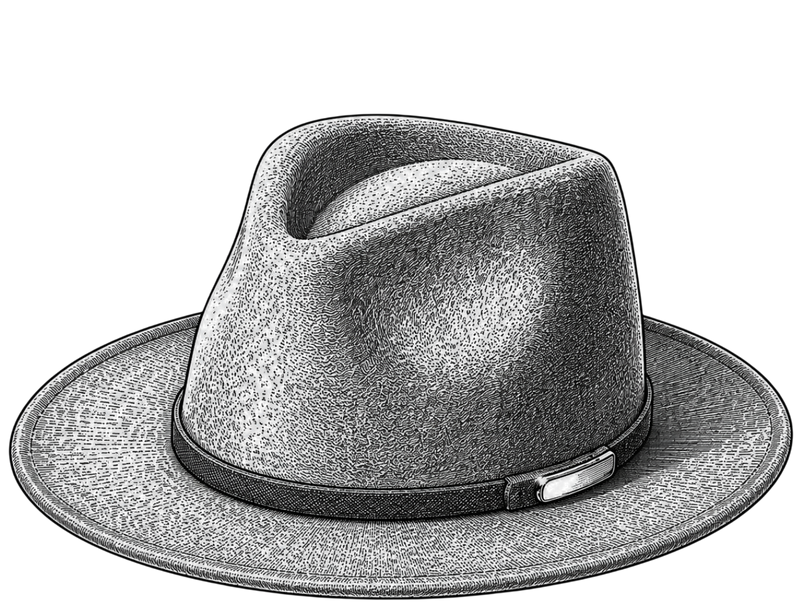
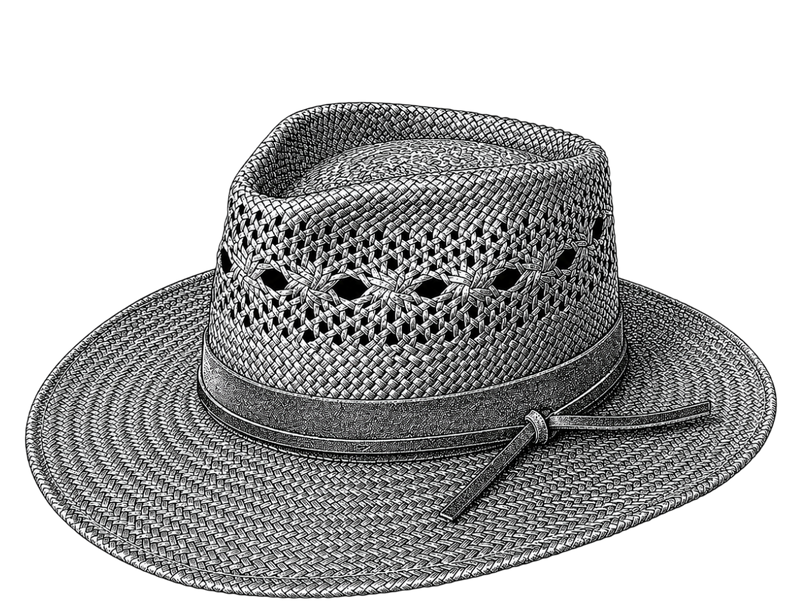
Counter to this simplification, the hatband became a personalisation point for hat collectors and enthusiasts: natural leather bands, woven fabric bands, chains and metal elements, wide silk bands, and no band at all (the raw-crown or clean-crown look popular in Western-influenced hats) have all been used as individual statements within the last 30 years.
How to Read a Hatband Today
Contemporary hatband choices signal hat category and wearing context:
- Solid narrow grosgrain (black, dark navy, dark brown): classic, versatile, indicates a well-made hat used across formal and casual contexts. The most conventional and least obtrusive option.
- Wide grosgrain or ribbon: a wider band (over 3 cm) is a more decorative choice, reads as fashion-forward or retro, often signals that hat aesthetics are a priority for the wearer.
- Stripe pattern: club or regimental aesthetic; reads as British traditional or sporting. Works with boaters, straw hats, and some fedoras in casual contexts.
- Natural leather band: associated with Western hat traditions, outdoor and country contexts. Looks deliberate against felt; natural against straw.
- No visible band: the raw Optimo style (where the brim meets the crown without an added band) or the bound crown reads as either purist quality or a contemporary minimal aesthetic.
Browse hats with classic and contemporary hatband styles at Hatloom.
Frequently Asked Questions
Can you replace or change a hatband?
Yes, and this is one of the more accessible hat customisation options. Most factory-installed grosgrain hatbands are attached with small stitches at the bow/overlap point and held by the physical tension of wrapping the crown -- they can be removed by carefully snipping the attachment stitches without damaging the hat. Replacement bands can be purchased as pre-cut ribbon lengths from millinery suppliers or as specific hat ribbon products. Replacing a hatband with a different colour or width is a reasonable DIY customisation for a hat you want to refresh or personalise.
What does the bow position on a hatband mean?
The bow or overlap -- where the two ends of the hatband ribbon meet and are folded or tied -- is conventionally worn on the left side of the hat (when looking at the hat from the front, the overlap is on the wearer's left). This has been the standard in Western hat tradition since approximately the early 20th century and has no strong functional reason -- it is a convention that became standard. Some hat styles (certain British country hats, some military-influenced styles) place the bow at the back. There is no practical significance to position; the convention exists to give the detail a defined place.
What width hatband is considered classic?
A band width of approximately 2-3 cm (just under 1 inch to just over 1 inch) is the classic proportional range for a standard fedora-style hat. This width is visible without being dominant -- it frames the crown base without competing with the crown and brim as the major visual elements of the hat. Narrower bands (under 1.5 cm) read as more delicate or minimalist. Wider bands (over 4 cm) read as decorative or fashion-forward. The 2-3 cm range is the most versatile and the most widely used in quality hat production.
Are hatbands matched to the hat or to the outfit?
The hatband should first be in proportion and material relationship with the hat -- a narrow silk band on a heavy felt hat, or a wide casual band on a fine Panama, creates a mismatch between hat and band that is visible to anyone familiar with hat conventions. Once the band is appropriate for the hat, secondary coordination with the outfit is straightforward: a black band coordinates with dark clothing; a brown or tan band with earth tones; a navy band with blue and grey tones. The coordination logic is the same as accessories generally -- the band is one element in the outfit's colour relationship, not the primary driver of it.
What is the significance of a feather in a hatband?
A feather in the hatband has a documented history as a military honour marker (feathers representing enemies defeated or victories achieved in various European traditions), a craft association (hat makers historically inserted a feather as a proof-of-quality mark -- the origin of the phrase to put a feather in one's cap), and a regional identity marker (Tyrolean and Alpine traditions use specific feather types to indicate regional affiliation). In contemporary use, the feather in a hatband is primarily aesthetic -- it is associated with Tyrolean, Alpine, and certain country hat traditions, reads as informal, and is appropriate on felt fedoras and hiking-style hats rather than on fine dress hats where it would read as decoratively inconsistent.