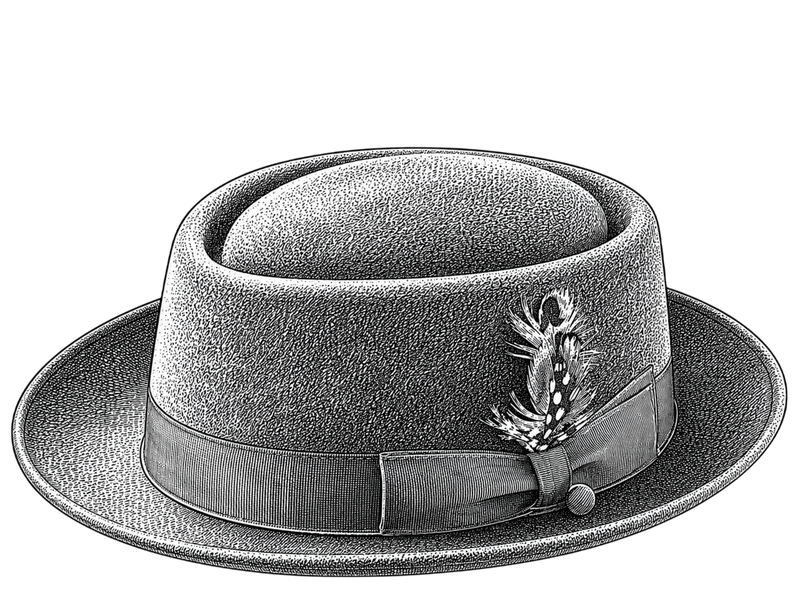
A finished felt hat looks simple. The process that produces it is not. Wool felt hat making involves chemistry, heat, pressure, and manual skill in proportions that have changed little in four hundred years — because the material itself has not changed, and neither have the physical principles that govern it.
Understanding how a felt hat is made explains why good ones cost what they cost, why they last as long as they do, and why cheap alternatives fail in specific, predictable ways.
Step 1: The Raw Material
Quality felt hats begin with fiber — wool, rabbit fur, or beaver fur, depending on the intended quality tier.
Wool felt: The most common material for mid-range and accessible quality hats. Wool fibers have a microscopic scale structure on their surface — when agitated with heat and moisture, these scales interlock with each other, creating a dense, cohesive fabric without weaving or knitting. This process is called felting.
Rabbit fur felt: Finer than wool, with a denser, smoother surface and better natural water resistance. The standard material for better-quality mid-range hats. A good rabbit felt hat at $120–$200 will outlast multiple wool felt hats at the same price point.
Beaver fur felt: The historical premium standard for hat making since the 17th century. Beaver fur has the finest scale structure of any commonly used hat fiber, producing a denser, more water-resistant, and more durable felt than either wool or rabbit. The over-hunting of beaver for hat making was a significant driver of North American beaver near-extinction in the 18th and early 19th centuries. Modern beaver felt hats use farmed or ethically sourced fur.
Step 2: Carrotting and Fur Preparation
Raw animal fur cannot be felted directly. The fiber tips must be roughened or treated to enhance the interlocking scale action that creates felt. Historically, this was done using a mercury nitrate solution applied to the fur — a process called carrotting (the mercury turns the fur orange). Hatters who worked with mercury nitrate over years developed neurological damage from chronic mercury vapor exposure — the origin of the expression mad as a hatter.
Modern hat making uses safer chemical equivalents that achieve the same surface roughening effect without mercury. The carrotting step is still part of quality felt preparation, but the chemical has changed.
Step 3: Forming the Cone
After preparation, the loose fur fibers are deposited on a cone-shaped form and treated with steam and agitation to begin the felting process. At this stage, the material is called a hood or cone — a loose, large, fragile cone of partially felted fiber that is three to four times the size of the finished hat.
The oversized cone is not a mistake — it is intentional. The subsequent shrinking and densification process relies on having enough fiber present to compress into the finished density.
Step 4: Hardening and Shrinking
The cone is progressively shrunk through repeated application of hot water and pressure — manually rolling and working the cone against a hard surface. Each pass further interlocks the fibers and reduces the size and increases the density of the cone. A cone that starts at 60–70 cm tall may end the hardening process at 25–30 cm — a reduction of 50–60% in size with a corresponding increase in density and structural integrity.
This stage requires skill and time. Rushing it produces a hood with uneven density — thin spots that will be fragile in wear and thick spots that block the steaming and shaping in the next stage. Handmade premium hats have more even density than machine-processed equivalents because the manual process allows the maker to feel and correct inconsistencies.
Step 5: Blocking — Creating the Crown Shape
Blocking is the stage most associated with the hat maker craft. The hardened hood is wet, placed over a wooden block in the shape of the intended crown, and stretched into position using hands and tools. The wet felt conforms to the block shape precisely — the block is the mold, and the quality of the block determines the quality of the crown shape.
Blocking is done on custom-made wooden blocks shaped to specific hat designs. A hat maker with a complete library of blocks can produce dozens of different crown shapes. Hat makers without complete block libraries are limited in what shapes they can produce.
After stretching over the block, the hat is dried in the correct shape. When it dries, the felt holds the block shape due to the interlocked fiber structure — this is why felt hats can be reshaped with steam, and why steam-reshaping works: it temporarily re-softens the fiber bonds that were set during the original blocking.
Step 6: Brim Forming
With the crown blocked and dried, the brim is formed — stretched over a flat brim former to the correct width and angle. The brim edge is the most vulnerable area in wear, which is why quality hats bind the brim edge with grosgrain ribbon or other material to reinforce it.
Brim stiffness varies by hat style and manufacturer. Stiffener (a shellac or acrylic compound) is applied to the underside of the brim to give it the correct amount of rigidity. Over-stiffened brims crack; under-stiffened brims flop. The correct balance is specific to the hat design and intended wear conditions.
Step 7: Finishing
The finished blocked hat is sandpapered or ironed to create a smooth surface, then finished with a nap (a slightly raised, directional surface texture) or left smooth depending on the intended aesthetic. The sweatband, decorative ribbon, and any trim are added by hand at this stage.
The finishing step is where the most visible quality differences appear: the evenness of the surface, the precision of the ribbon placement, the quality of the sweatband material, and the neatness of the hand-stitching that holds internal components together.
Machine vs. Handmade: What the Difference Means
Modern hat production exists on a spectrum from fully automated to fully handmade. Automated production:
- Uses mechanized cone formation and shrinking processes that are faster and more consistent in volume
- Uses hydraulic or pneumatic blocking that replicates the block shape precisely but does not allow for real-time adjustment of density variations
- Finishing is still largely manual — a machine cannot reliably sand a hat surface evenly or place a ribbon precisely
Handmade production:
- Allows the maker to feel and correct density variations at every stage
- Uses the maker skill and judgment to produce crown shapes that a machine cannot adjust in real time
- Is significantly slower and therefore more expensive
- Produces hats with better material consistency, more precise crown geometry, and longer lifespan due to more even density
The difference is visible and tactile. Hold a handmade felt hat and a machine-processed hat of equivalent fiber content simultaneously — the handmade hat feels more coherent, denser at each point, and more structurally resolved.
Why Good Hats Cost What They Cost
A quality handmade rabbit felt fedora at $150–$250 has approximately $20–$40 in raw material cost. The remainder is labor — skilled, specialized labor that takes years to develop and cannot be easily scaled. There are fewer working hatters today than at any point in the past 200 years.
A $30 felt hat has approximately $5–$8 in raw material. The process savings come from lower-grade wool, automated production, and minimal finishing. The hat will perform correspondingly.
Find quality handblocked and machine-made felt hats with transparent material information in the Hatloom collection.
Frequently Asked Questions
What is felt made of?
Hat felt is made from animal fiber — typically wool, rabbit fur, or beaver fur — that has been matted and compressed through heat, moisture, and agitation until the individual fibers interlock into a dense, cohesive fabric. Unlike woven or knitted fabrics, felt has no yarn structure — the fibers bond directly to each other.
What is the difference between wool felt and fur felt?
Fur felt (rabbit or beaver) uses finer fibers with a more pronounced scale structure than wool. This produces a denser, smoother, more water-resistant felt with better shape retention. Wool felt is coarser, less water-resistant, and less durable, but significantly less expensive to produce. The quality difference is visible and tactile at equivalent fiber weights.
Why is beaver felt so expensive?
Beaver fur has the finest, most developed scale structure of commonly used hat fibers, producing the densest and most durable felt. Sourcing is more limited than wool or rabbit. The processing is more complex. A genuine high-grade beaver felt hat represents the premium tier of felt hat manufacturing — a quality that compounds over time as the hat ages and continues to perform.
Can a felt hat be reshaped after blocking?
Yes — this is a fundamental property of felt. Steam temporarily re-softens the fiber bonds that were set during original blocking, allowing the hat to be reshaped by hand or block. When it cools and dries, it holds the new shape. This is why dented felt hats can be restored at home with steam and gentle reshaping.
How long does it take to make a quality felt hat by hand?
A skilled hatter making a quality handblocked fedora from processed hood to finished hat requires approximately 2–5 hours of active work, spread across a day or more to allow for drying at each stage. The cone preparation (carrotting, forming, hardening) may add several hours of processing time before the blocking stage begins. Fine hat making at the highest quality tier can take 8–12+ hours for a single hat.