Women's hat history through the 20th century is a timeline of social upheaval wearing itself on the head. Every major shift in hat fashion corresponds directly to a shift in how women were permitted -- or chose -- to exist in public life. Reading the hats is reading the century.
1900-1919: The Enormous Brim Era
The Edwardian hat -- wide as a dinner plate, decorated with entire birds, feathers, flowers, and ribbons -- was a status object requiring a domestic servant to pin it in place and a carriage to travel without crushing it. The hat's size signalled two things simultaneously: that the woman had money (the hat was expensive), and that she was not required to work (the hat was impractical for labour). Women's suffrage movements of this era wore deliberately simpler, more functional hats as a political statement of practicality and working-world readiness.
The First World War began dissolving this silhouette. Women in war-related work could not wear 50-cm-wide hats in factories, offices, or transport roles. Brim sizes contracted sharply between 1914 and 1918. By 1919, the Edwardian hat was already a relic.
1920s: The Cloche and the Short Hair Revolution
The cloche hat -- a close-fitting bell-shaped hat worn low on the forehead, often covering the eyebrows -- is inseparable from the post-war social transformation of women's public life. The hat required short hair; short hair required the hat. The two together signalled the same thing: modernity, mobility, and a deliberate rejection of the elaborate femininity of the previous generation.
The cloche worked with the geometric lines of 1920s dress -- dropped waists, flat fronts, minimal curves. It was an architectural object on the head, not a decorative one. This was also the era when mass manufacturing began to make fashionable hats accessible beyond the wealthy -- the hat became a working woman's accessory as well as a society woman's status object.
1930s: Sculptural Minimalism and Hollywood Influence
The Depression-era hat became smaller and more precisely shaped -- not because of fashion restraint, but because material economy and mass cinema created a new hat aesthetic. Hollywood close-ups required hats that framed the face without obscuring it. The 1930s hat tilted -- forward, to the side, at dramatic angles -- because a tilted hat with a narrow brim worked on film in ways that an enormous Edwardian hat could not.
Significant styles: the pillbox (a small, flat-crowned cylindrical hat), the beret (absorbed from military and art circles into mainstream women's fashion), and small-brimmed cloches that had evolved from the 1920s toward sharper, more sculpted forms.
1940s: Utility and Invention Under Restriction
Wartime material restrictions in Britain, the United States, and Europe produced one of the most inventive periods in hat design -- because fabric was rationed but head coverings were not subject to the same restrictions. Milliners produced hats from anything available: felt scraps, dyed paper, woven straw, wrapped turban fabric, flowers, feathers, and found objects.
The 1940s hat was often elaborate in construction while minimal in material -- a small base with significant architectural or decorative work on a very small amount of fabric. Turban styles became dominant by mid-decade, particularly in the United States, as they required minimal material, kept hair tidy under factory conditions, and could be styled quickly. The 1940s turban is simultaneously a fashion object and a functional wartime solution.
1950s: The Post-War Hat as Dress Code
The 1950s represented the last decade in which hats were a required element of women's formal and semi-formal dress in Western countries. Appearing in church, at formal events, in upscale shops, or at social occasions without a hat was considered incomplete dressing for a woman.
Hat styles of the decade reflected the structured femininity of 1950s fashion overall: precisely made, often matching in colour and fabric to a coat or suit, and worn at specific angles that had social code built into them. The pillbox hat, the picture hat (wide-brim, theatrical), and the off-the-face hat (brim pinned up to reveal the full face) were major styles. Millinery as a skilled trade was at its professional peak in the 1950s -- hat-wearing demand supported thousands of milliners across Western Europe and North America.
1960s: Decline of the Hat as Social Requirement
The 1960s produced the hat's collapse as a social requirement in most Western contexts. Several intersecting forces: the Kennedy administration and its cultural effect (Jackie Kennedy's pillbox hat becoming iconic while simultaneously suggesting that hats were exceptional rather than routine); the shift toward hairdryer-styled hair as a fashion priority (big hair and hats are mutually exclusive); and the broader social liberalisation that dismantled dress codes generally.
By the late 1960s, hat wearing among younger women had largely become optional, reserved for special occasions, or replaced by scarves and headbands. The millinery trade began contracting sharply. Hat factories that had operated for generations closed or reduced capacity significantly through the 1960s and 1970s.
1970s-1980s: The Hat as Statement Rather Than Convention
Without social requirement, hats became individual choices -- and individual choices are louder than convention. The 1970s wide-brim hat, the 1980s oversized felt hat, and the 1980s power-dressing structured beret all functioned as explicit statements about identity and aspiration rather than simply as correct completion of a formal outfit. This era produced some of the most dramatic hat shapes of the century, partly because dramatic hat-wearing was no longer moderated by the expectation that most women in any room would be wearing one.
1990s-2000s: The Hat's Retreat to Sub-Culture
General women's hat wearing retreated through the 1990s and 2000s to specific contexts: formal events, weddings, racing days, and sub-culture communities (hip-hop bucket hats, indie aesthetic fedoras, Britpop band aesthetics). The hat became a meaningful object precisely because it was no longer routine -- wearing one required intention and invited interpretation in a way that had not been true for most of the century.
2010s to Present: The Hat's Return as Personal Expression
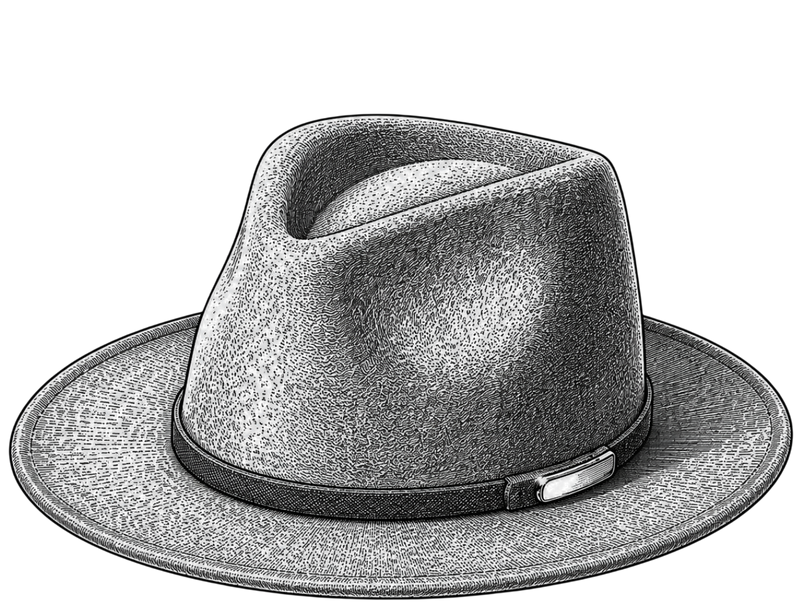
Hat wearing among women began increasing again through the 2010s -- not as a return to social obligation, but as a deliberate personal expression within a broader fashion culture that values visible individuality. The wide-brim felt hat became a dominant visual element of festival fashion. The bucket hat completed its cycle from utility to hip-hop sub-culture to mainstream acceptance. The beret found another generation of adopters.
The current hat moment is the first in 20th/21st century history where hat wearing has no mandatory social dimension at all -- every hat wearer has actively chosen to wear a hat. This selectivity has raised the quality of hat culture: people who actively choose hats are more likely to wear them correctly, care for them properly, and invest in quality.
Browse women's hats across all the styles that have defined hat history in the Hatloom collection.
Frequently Asked Questions
When did women stop wearing hats as a daily requirement?
The shift happened primarily through the 1960s in Western countries. Hat wearing as a social requirement for formal contexts (church, workplace, formal events) was effectively dissolved by the end of the decade. The process accelerated in the early 1960s and was largely complete by 1970. Regional and cultural variations existed: hat-wearing conventions persisted longer in rural contexts, in certain religious communities, and in formal institutional settings.
What caused the decline of the millinery industry?
Multiple intersecting causes: the end of hat wearing as a social requirement eliminated the mandatory market; the rise of car travel (hats and car roofs are in conflict) made hat-wearing less practical; the shift toward hairstyle as fashion expression made hats an interference rather than an addition; and the cost of skilled millinery labour relative to the price the reduced market would support made many hat businesses economically unviable. The millinery trade did not disappear -- it contracted from a mass-market industry to a speciality craft serving formal, theatrical, and fashion markets.
What is the significance of the cloche hat?
The cloche (French for bell) is significant beyond fashion for two reasons. It was the first hat style in Western history specifically designed for women with short hair, making it a material marker of the post-WWI transformation in women's social position. And its close-fitting, low-fronted design covered the hairline and much of the face, creating a specific modernity aesthetic -- the woman wearing it revealed less of her face, which was simultaneously more mysterious and more urban than the full-face openness of earlier hats. The cloche was worn from approximately 1920 to 1933, and its concentrated cultural moment makes it one of the most specific period-markers in fashion history.
What was Jackie Kennedy's influence on hat fashion?
Jackie Kennedy's pillbox hat, worn at the 1961 inauguration, became one of the most reproduced hat designs in American fashion history -- Oleg Cassini's version was copied at every price point within weeks. Its cultural effect was paradoxical: the image became iconic and the hat became associated with a specific era of elegance, but the overall trend toward hat-wearing as social requirement was already declining by 1961, and Kennedy's personal style reinforced hat-wearing as an exceptional, considered choice rather than a routine one. The pillbox hat became the hat of special occasions rather than the hat of daily life.
Are hats more or less popular for women now compared to the mid-20th century?
Significantly less in total volume -- a 1950 count of women wearing hats in any public space in a Western city would show a large majority of women covering their heads. Today's equivalent count would show a small minority. But the hats being worn now are worn with more intention, more knowledge, and more care than mandatory convention ever produced. The population of hat wearers is smaller and more engaged with hat culture than the full-coverage era of the 1940s and 1950s.